Zara Larsson Is for the Girls
by Bea IsaacsonJan 26, 2026
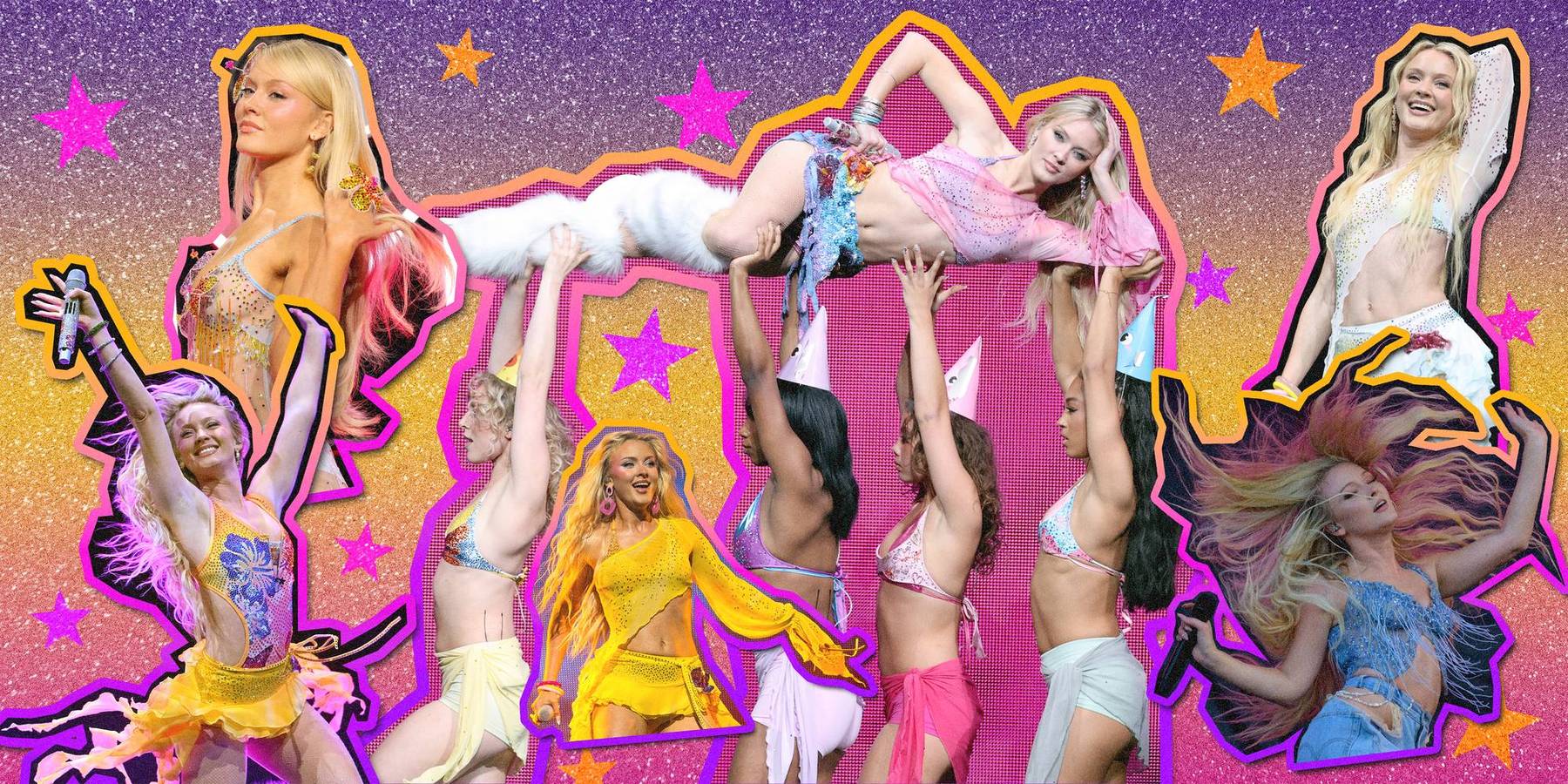
Glittering seas and galloping dolphins. Y2K halter-necks and low-rise silhouettes. Shimmering eyeshadow and miniskirts so short somewhere Bridget Jones’s lothario Daniel Cleaver is emailing to enquire: Is skirt off sick? And, obviously, that Tiffany Pollard feature.
Zara Larsson has not exactly burst onto the scene. 2026’s hottest pop star has been around since her 2014 hit Lush Life, released when she was just 17 years old. Before that, Larsson was a singing competition child prodigy in Sweden. But she has stormed the world stage, right under the harsh attention of the limelight, with the brilliant success of Midnight Sun. How did she finally make it happen?
Midnight Sun is not a concept album as much as it’s a tight commitment to a searing aesthetic. It’s a meticulously produced, sonically seamless pop record that understands the current course of pop being more than just a sound, but a curatorial approach to vibes-making, from the music video fonts to the well documented make-up looks on the road, opening for Tate McRae on her North American leg of the “Miss Possessive Tour.” Her long blonde hair, brilliant abs and shaking ass has dominated all corners of the internet.
Not the heterosexual male corners, as one would, historically, assume. The girls and gays corners. Which begs the question: Why is this scantily dressed, absolute bombshell blonde performer, who dances sexily both on stage and in music videos, and comes across on all forms of media as confident, cool and kind, not a presence within Straight Man World? Why is Zara Larsson – a chart topping musician across the US and Europe – a figure predominantly, if not almost exclusively, for the women and queer community?
It’s the economy, stupid. Not in the Bill Clinton way – always a topical name for any discussion on Straight Man World – but rather, an example of a savvy understanding of this current pop culture climate. Despite her dancing and in spite of her beauty, there is nothing about Zara Larsson’s public persona that shows any interest in capturing the validation or even attention of straight men. Instead, she has successfully targeted the queer community – gay men, especially – by working with queer icon MNEK, “littering her lyrics with gay slang”, my friend Charlie, an openly gay man, tells me, and crafting a sound that marries contemporary electro and dance sounds with Swedish pop.
Sweden is also the home of gay icon Robyn and, obviously, ABBA. The generational music lineage sets a wonderful precedent.
Zara is not the only pop girl of her generation that is deliberately marketing herself to both young women and queer people. It’s a contemporary shift seen across her peers, from up and comers like Slayyyter and PinkPantheress to the more tenured Sabrina Carpenter, even Addison Rae, or, the reigning queen of modern pop, Charli xcx. There is an undeniable pendulum swing within the world of music and the young women that currently dominate it. Today, pop music is largely hyper, club-friendly and sexy again, in a manner not seen since the noughties heyday of Britney Spears, Christina Aguilera, and Shakira or later contemporaries like Rihanna.
But unlike their foremothers, the girls – women, obviously, but girls in the new meaning of the term – are simply not battling it out for male attention. Gone are the days of Xtina surrounded by men in a boxing ring, or Britney dressed as a schoolgirl in class while men in media melted down. And subsequently, gone are the days of these women’s teams throwing multi-million dollar budgets into catering to a gaze that will tear them down the second they can, a society embedded with a misogyny that demands any woman exhibiting sexual prowess is open game for tabloids leering at their weight gain, public figures laughing at their mental health, fellow musicians rapping about fucking them.
It would be lame to simplify matters and suggest this doesn’t exist anymore, because it does. But the climate has changed considerably: that kind of sexism is less obnoxious and obvious. When it is, it’s less tolerated than a few decades ago, and the pop stars — and their fans — feel equipped and enabled to fight it. They’re political in general. Sabrina Carpenter referred to Donald Trump as “evil and disgusting,” holding an “inhumane agenda.” Chappell Roam turned down the offer to perform at the White House Pride. Billie Eilish denounced ICE in an acceptance speech. Taking to Instagram stories, TikTok and interviews, Larsson is one of the most outspoken figures of this current pop scene, expressing why she hates ICE, why she stands with immigrants, stands with Palestine, stands with criminals.
So they’re not playing to the male imagination, and they’re unapologetic about expressing their politics. Which brings a deliciousness to their repurposing of traditional female symbols and daydreams of a shared girlhood – the sequins, the glitter, riding on a pony and dancing on the beach – within their iconography. It’s fun, it’s tongue-in-cheek, it is years of content and context that is purposefully exclusive to the straight man. It even comes with its own lexicon. Has anyone tried explaining to a straight guy what “Khia Asylum” means recently?
And this carved out space is as present online as it is offline. Part of Larsson’s success is down to her chronic online-ness, perhaps most notably the TikTok dolphin moment that swept the app in 2024. “Trying to think of ways to milk this dolphin trend so I can sell out my US tour,” she said of the sudden “Symphony” revival at the time. She’s not interested in being mysterious or coy; Larsson is appealing directly to her audience, displaying a sense of humor and camaraderie that speaks to those within that sphere of the internet. Users that are, predominantly, young women and queer people. These are social groups that are, in 2025, probably the bulk of pop music listeners. It’s the live music sales and merch economy… stupid!
It’s a successful tactic that has been mirrored by others outside of pop. Kylie Jenner has distanced herself from the declining interest and subsequent social capital of the rest of her sisters within this group by presenting herself as a ‘girl’s girl’ on TikTok – a term used by Larsson as a Midnight Sun song track – openly replying to users about the details of her boob job. And in this constant war between Selena Gomez and Hailey Bieber stans, where the two groups throw vitriol against each other with such fierceness it makes Trump look like a deserving Nobel Peace Prize winner in comparison, the recurring allegation used to demerit the other woman is that she is not a ‘girl’s girl’.
This bleeds into the offline world. Taylor Swift’s alleged diss track against Charli XCX on her most recent album The Life of a Showgirl went down terribly with this cohort. Cultural commentators were quick to point out that while Charli proved herself as someone who uplifts her contemporaries through collaborating with other artists, Swift seemingly stomps on them, accusing arguably her biggest rival for pop domination of being obsessed with her. When she pulled this tactic with Katy Perry in their 2015 feud, utilising a literal army of her celebrity female friends in her music video “Bad Blood”, it was seen as a huge win. A decade later, the pop public has decided that actually, Charli XCX and Lorde candidly singing about their insecurities on “Girl, so confusing” is the new zeitgeist.
If Zara is reflective of a new generation of women in pop, then that generation is as fearless in celebrating their bodies and sexuality as they are unapologetic in expressing their thoughts, whether that be their humour or their politics. The girls’ girls may be pop in sound, and kitschy in aesthetic, but they’re rock and roll in action.
Graphic Design by Jewel Baek
Images via Getty