The Lost History of Madonna, Children's Book Author
by Russ MartinJan 27, 2026

Everyone knows Madonna’s book Sex.
In 1992, two days after the release of her fifth studio album, Erotica, Madonna famously published a coffee table book featuring black and white photographs by the acclaimed fashion photographer Steven Meisel. It depicted the pop star tied up, bare breasted and engaging in various types of BDSM. Sex sold half a million copies in a week and topped The New York Times Best Seller. Entertainment Weekly called it “the literary event of the century.”
It was also incredibly controversial, widely panned upon release. Sex probably hurt sales for Erotica, though Madonna was unphased. She coyly responded on her next record, Bedtime Stories: “Oops, I didn't know I couldn't talk about sex.”
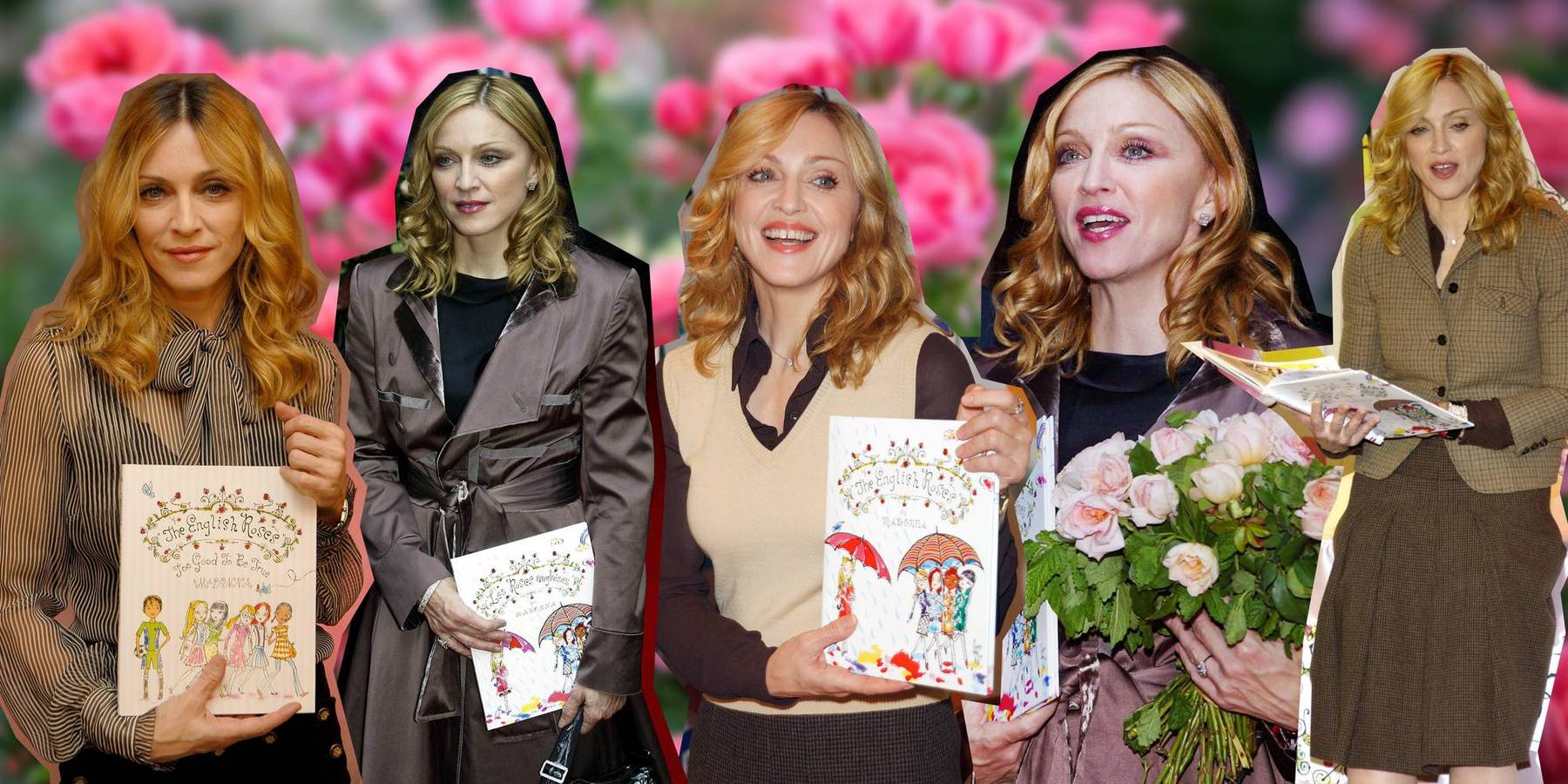
Her next big literary foray is perhaps less remembered, though it did even bigger initial sales: one million copies shipped out around the world upon release. In 2003, while living in London, Madonna published her first children’s book, shocking yet again with one of her most surprising reinventions up to that point. Her children’s book series, The English Roses, tells the story of a young girl named Binah who is being excluded by a clique of pre-Mean Girls mean girls. In interviews, Madonna revealed Binah was partially a stand-in for her daughter Lourdes, then a primary school student. Lourdes, Madonna explained, was having problems with a group of girls one of Lourdes’ teachers had coined The English Roses, a moniker Madonna snatched and sent to the printers.
Not done courting controversy, the first book would release just weeks after Madge infamously kissed Britney Spears at the 2003 MTV Video Music Awards.
She introduced the book – the first in what became a series – at The Roof Gardens, a private rooftop garden just around the corner from Kensington Palace and Hyde Park. Deeply into her English mum era as Mrs. Guy Richie, the Material Girl served mini cucumber sandwiches and cupcakes to British celebs and literati types like the food writer Nigella Lawson, essayist Martin Amis, designer Stella McCartney and a couple EastEnders actors.
Then, with her children Lourdes and Rocco in tow, she put on a pair of glasses and perched on a swing to read her book to local schoolchildren and a handful of celebrity spawn.
Elsewhere on the roof was the illustrator Jeffrey Fulvimari, her creative partner in the endeavor. An artist who’d come up in New York just a few years behind Madonna and haunted the same clubs, from The Palladium to The Pyramid, Fulvimari was besties with David LaChapelle and had worked as a model, including appearing alongside Kate Moss in one of her iconic Calvin Klein ads. By the 2000s his career as an illustrator had taken off, and he was selected to bring a fashionable eye to the project.
Below, Fulvimari reflects on getting caught up in the whirlwind of Madonna’s world and the impact of The English Roses.


What kind of work were you doing when you got the call to work on a book with Madonna?
I’d worked for Barney's, I worked for Interview, for Paper, back when Mickey [Boardman] was the receptionist. Then at that point I was doing a lot of merchandising, I’d just started a large merchandising program. And everybody told me not to do the book, because I didn't need to do it, but I wanted to work with Madonna.
I moved to the East Village in 1982. I was kind of, like, a few classes below, like I was a freshman and Madonna was in college already. I used to see her in clubs a little bit and I didn't know who she was 'cause she wasn't famous yet. Then, her record, “Everybody” came out and when I saw her on the album cover, that first album, I remembered having stared at her at a club I had just gone to. There were only like 30 people there. She was dancing and it was really memorable.
Everyone I knew knew her, but I had never met her. Cut to when I moved to Woodstock, I got a call from Callaway, who was the publisher. I knew some people that worked there already because my best friend the whole time I was in the East Village was David LaChapelle. And I had helped David edit his books with Callaway.
They called me and said there's a celebrity who did a book, a children's book, and they wanted me to kind of audition for this project, but they wouldn't say who it was.
Why did people tell you not to do it?
It was Madonna, so everyone had an opinion. And then, once it happened, then everyone came out of the woodwork. It got really crazy. Everybody thought that I was the person that was gonna introduce them to Madonna and they were going to become best friends.
Did you actually meet Madonna?
I did meet her at the launch in London. And then we all went to Paris and had another launch party there. She was very involved in the book and also Lourdes was as well. Lourdes was probably like 11. She sent me a book of photos, like a photo album. I think they were photos that she had taken herself of the estate that she lived on at the time in London. There were all these little yellow Post-It notes in it with scribbly handwriting. I realized years and years later that it was her handwriting and she had put this together herself.
I realized what an incredible art director she was and you know how fluent she was in that language. She made very specific requests. There was one illustration of Binah's bedroom, Binah's the main character, and she's sort of poor. She lived with her father and she was an only child and her mother had died and she had kind of like this attic bedroom that was a little bit rundown and Madonna listed all the books that she wanted on the bookshelf.
Oh, wow.
That's just one example. She was really, really, really involved in that way and it was surprising.
I walked away with the impression that she's a brilliant art director. A lot of people think that she hired art directors and that's why she became who she became. But you know, I don't really think anybody art directs her.
I've been reading about the London launch of the book. It strikes me as very characteristic of this moment in which she's doing motherhood and doing family life and sort of reinventing herself in British society. Stella McCartney was there! What do you remember?
I remember that Nigella Lawson was there. I missed Stella McCartney because Madonna doesn't sign autographs. Because if she had signed one, she'd have to sign 8,000 and, so I was the one I had to. I think I was standing there for like five hours signing people's books. It was a really, really long line.
It was fun, but I totally missed Stella McCartney and I really wanted to meet her. The next day I made a drawing and took it to her shop and wrote a little note like, you know, “I really, really wanted to meet you, I'm sorry.” And she wrote back and that was nice.
What else do you remember about that time?
Weird things happened that you wouldn't imagine. My niece, who is, like, 33 now, she was in grade school at the time and I came back home and spoke to her class.
The teacher, this young woman, was very nice, but she made a quilt for Madonna. To give to her. And she spent all this time doing this quilt. She wanted me to give it to Madonna, and she didn't understand that I, you know..I didn't have access to her in that way. It was a little awkward. She was furious. She wanted to kill me.
Oh wow.
I did speak to [Madonna] on the phone a few times… She gave her number. And then after the call I thought, you know, I don't want this number because I don't wanna ever be tempted to bug her. And I threw it away.
I have never been great with celebrities. I get really nervous, I'm not someone that can just be like, “Hey, how, you doing?” Back in the day, when David [LaChapelle] and I both lived in New York [his] studio, it was just like a revolving door, like Dolly Parton, Drew Barrymore, and a lot of times I would be there when those people were there. Are you familiar with David's work?
Of course, yes.
Do you know the [Liza] Minelli pictures that he did where she had beads in front of her face? I was on a ladder holding the beads.. That's how it was. So many crazy experiences I can't even remember.
When I was around her, it wasn't like I was gushing, it's just that I kind of shut down. I'm kind of an awkward, introverted person really, even though I was a model, and out in the club world. Back in the day, the music was so loud you didn't really have to talk.
When you think back on it now, what do you think is the book's legacy?
Well, the interesting thing about it is that all of those little girls who read that book are like 31 now. They're running things! Most of the DMs I get from strangers are like, “I read the English Roses when I was young. It really influenced me.” It had a big impact on girls of that time.
It feels great. I love that it's kind of like, you know, the artist who did Madeleine or the artist who did Eloise. I feel like I'm kind of in that club now.
Graphic Design by Jewel Baek
Images via Getty