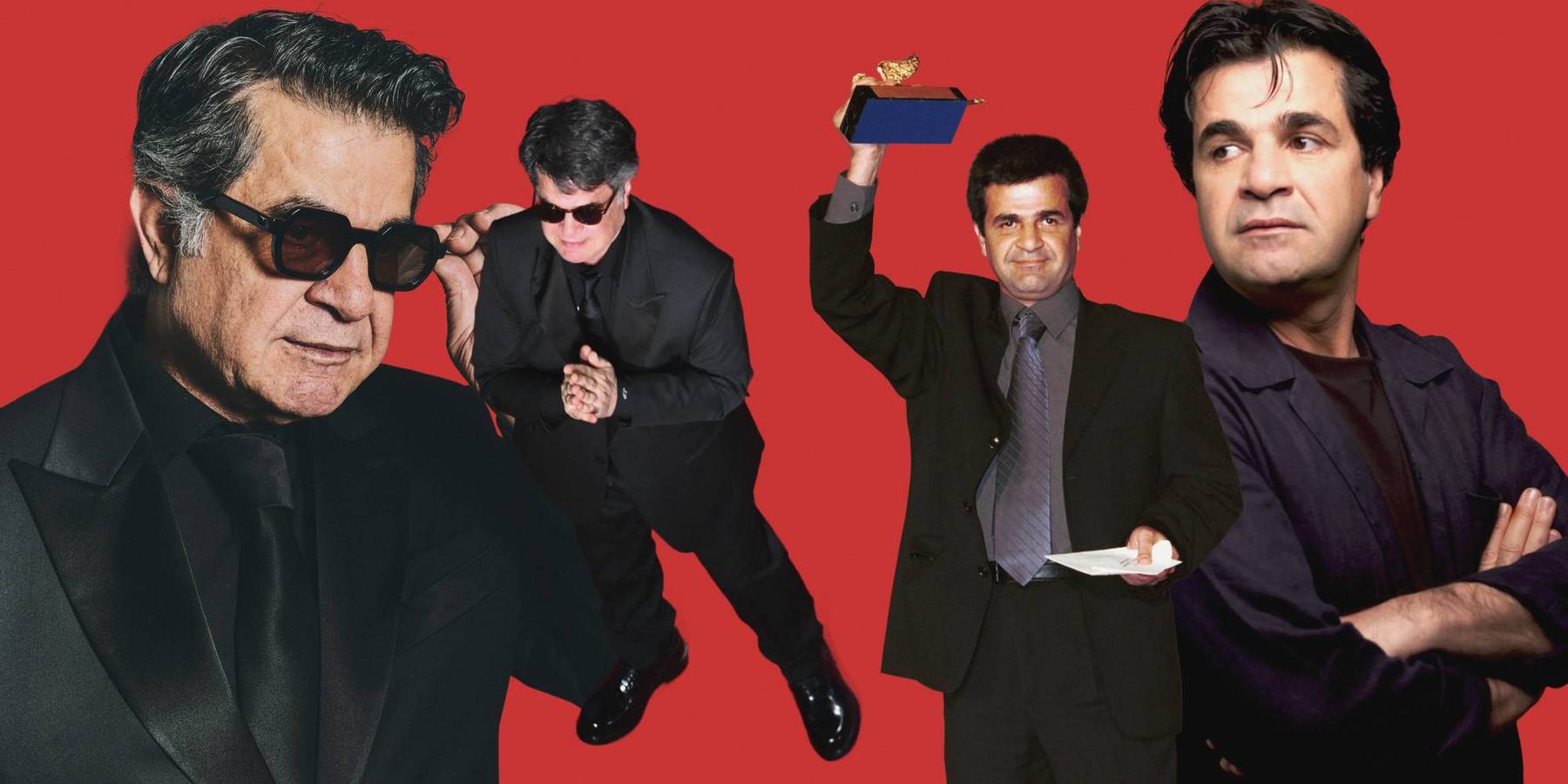
Jafar Panahi Will Go to Prison and Write Another Movie
by Sam BodrojanFeb 27, 2026
It is impossible to talk about Jafar Panahi without talking about those who wish him silent.
Starting with 2000’s The Circle, the long-celebrated Iranian auteur has had his films either censored or outright banned. In 2010, Panahi was jailed and banned from making films for 20 years after Iranian authorities accused him of making propaganda against the Islamic state. He continued to make films in secret, filming and distributing them illicitly for twelve years. Between 2022 and 2023, he was imprisoned once again.
It Was Just An Accident, Panahi’s first film after the filmmaking ban was lifted, is a total masterpiece. The perfect synthesis of his early, cacophonous social fables with his tightly choreographed clandestine work, the film is a riveting thriller about political retribution and unresolvable grief. The film follows a mechanic who kidnaps a man that he believes, thanks to the sound of a creaky knee replacement, a soldier who tortured him in prison. When he begins to doubt his ears, he rounds up those he met in prison, enlisting them to identify their captive and figure out what to do next. The movie is a galvanizing work of entertainment, a film that takes the material realities facing countless Iranian citizens and treating them as worthy of the artistic examination typically reserved for religious texts.
It is intoxicating to see a filmmaker, forced to work for so long with maximal aesthetic and dramatic efficiency, once again operate on a comparatively large scale. At a time when many artists give glib statements proclaiming the best art as devoid of controversy, Panahi’s work stands as irrefutable argument to the contrary.His art confronts the most important social issues facing his country, treating these fundamental questions of Iranian life as the essential material of his rigorous, studied realism.
After winning the Palme D’Or at Cannes last year, It Was Just An Accident is now nominated both for Best International Feature Film at this year’s Academy Awards, as well as for Best Original Screenplay, alongside co-writer Mehdi Mahmoudian, who he met during his latest stint behind bars. Their shared experience with Iranian totalitarianism inspired the film — experience that is very much present-tense. This is not “over,” as Mahmoudian was released on bail last week after being arrested again last month, and Panahi will serve another year in jail once he returns to Iran after the Oscars.
He’s thus spent the past few months abroad, especially in the US, though America has certainly proven no escape from fascist action and censorship. Not that this is new for Panahi; In April 2001, he was notoriously detained by U.S. customs officers without reason overnight at JFK.
PAPER sat down with Panahi over Zoom to discuss the inspirations and process behind his recent film.
Your early films were about children. Thus you were called, early on, a children’s filmmaker. What principles of art making from this time do you feel have carried forward?
Because censorship is so severe in Iran, I, like many other filmmakers, started my first films focusing on children. At least at the time, films centered on children were less severely censored. Filmmakers took refuge in children, and through these children, they spoke the language of adults.
So I made my first two films centered on children, and they were extremely successful. Firstly, The White Balloon, which won the Camera d’or in Cannes. My second film, The Mirror, won the Golden Leopard at Locarno. This visibility endowed me with new possibilities. I started asking myself, “If these children were to grow up in this society, who would they become?” That's how I made my third film, The Circle. This is where problems began. [Laughs] The regime developed a great sensitivity, let's call it, to my work, and from that point onwards, never allowed for any other of my films to be screened in Iranian cinemas. Because instead of making films about children, I was making films about adults, the truth that they revealed about society in an almost naked, uncensored, transparent way were no longer acceptable to the regime; they had to be hidden.
You once said, while doing press for The Circle, that you do not like political movies, that you aren’t a political filmmaker. Has your relationship to this evolved at all?
No, no, I stand by my words. I'm not a political filmmaker; I’m a social filmmaker. I've stood on my words because I have a definition and understanding of what social cinema is. What is political cinema? I think political cinema is almost on party lines. It tells you what's good and it tells you what's bad. This person's a goody, this person's a baddie. Someone who is a member or stands by our party, they're good, and the one who doesn’t, is not. This kind of cinema is based on divisions and classifies and categorizes everyone from the get-go.
Whereas social cinema is entirely different, and it certainly does not judge people as good or bad. Rather, it portrays them all as human beings. Within the social cinema, of course, you may well work on a political subject matter, but it doesn't mean you've made a political film. For instance, if you were to work on war, it doesn't mean you've made a warmongering film. You have simply made a social film that pursues a political theme.
Now that goes for cinema. As a human being, the way you dress, the way you think, the way you speak, all of these can be political.
What formal developments do you feel you made while working under house arrest? How did they influence your form when filming in a comparatively uninhibited manner?
First of all, I should clarify that I've never been under house arrest. It’s fake news that's been circulating for some time. The sentence I had to abide by was the fact that I was banned from leaving Iran, not from leaving my home. You can also see it from my films, because, of course, in Taxi to Tehran, for instance, you see me traveling around town, or my subsequent films that I've made in villages. For instance, it's clear that I've left not only my home, but indeed my city.
And indeed social cinema means drawing inspiration from your society, from your city, from from the country as a whole. When you're used to being inspired by the society, the country, the people that surround you, you take that gaze with you wherever you go and you become influenced by whatever place and situation you happen to be in.
So if the regime puts me in prison, I will clearly both be influenced but also be inspired by that experience, by that place. Because I've lived with those prisoners, I've listened to them. We've confided our sorrows, our hopes to one another. The end result of all of this became It Was Just An Accident.
I wanted to ask about your collaborator, Mehdi Mahmoudian, if you wanted to speak to his virtues as a person and artist. Have you been in contact with him?
Yeah, I was just speaking to him three hours ago. He's just spent 17 days in prison. He came out on bail, and he's awaiting his court process. Altogether, Mehdi has spent about 1/4 of his life in prison. He is so mature and he's very good socially. Everyone in prison loved him, and he had really good relations with all his fellow inmates. He took great care of every new prisoner. In Iran, when you arrive in prison, you're stripped of all your clothes and your belongings, and you're left simply wearing your trousers and a sweatshirt.
So you have many needs — from clothing, both in the hot weather and the cold weather, to potentially health issues. Mehdi ensured that whoever arrived was taken care of. Mehdi knew every inmate, from their family problems to their culture, their way of thinking. Once I'd written the script, it was very important for me to go over it with Mehdi, and to check all the dialogue and make sure that they were in sync with the culture of the inmates. Not only the inmates, but also the interrogator.
Though you technically made this film after a lift on your filmmaking ban, you made this film under relatively clandestine circumstances. Were their parts of the production or the script that were influenced by what you could get away with?
I should clarify that actually I shot It Was Just An Accident more in secret than all the films I made since 2010, because it included a lot of exterior scenes. Those make you much more conspicuous. In Taxi To Tehran, I had three cameras inside the car that could not be seen from the outside. But in It Was Just An Accident, the camera eventually had to be out in the streets — where, of course, the regime would certainly get wind of what's happening. And in fact, they did. One day they raided the set. They took away all the cast and crew, they interrogated them, and they warned them that, were they to continue working on this film, they’d get into trouble.
But I scheduled the shoot in such a way to start with the less conspicuous material. By the time we were out in the streets, we'd filmed most of what we had to film. Even when we came to the city, we started with the scenes where the camera is inside the car, so that if they were to raid us, it was less of a problem because we’d shot most of what we wanted anyway. When we did encounter this problem, I stopped the work for one month, and then we went and in one day, very quickly, we shot everything we needed.
You said to Tehran’s Film Monthly in 1996 that in a film, a necessary sound for a film will be heard regardless of if one could have, in reality, heard it. “If we are open to hearing it, we will hear it.” It Was Just An Accident hinges on a central, single sound, but noisiness, an ambiance somewhere between subjectively evocative and anthropologically comprehensive, feels like a major throughline of your work. How do you feel your relationship to sound has changed over the years — in life, in art?
Sound is very important in all of my films, and I work very closely on it. Every single sound we hear must have its own meaning and must be there for a purpose. Because I don't believe in using music in my films or in cinema, I need to fill its space using sound.
For me, the problem of music and films is that if I cannot identify its source, I can't believe it. For instance, if there’s an orchestra playing, but I can't see it coming from a radio, I start wondering, “Where does this music come from?” And I stop believing in it. I usually sense that directors employ music once they have not been able to portray… to engender a feeling that they're seeking in other ways. For The White Balloon, I actually had two different scores composed. It was my first film, and so I was expected to follow a whole set of rules. In the end, I wasn't convinced, and I decided not to use it. In the film, you only hear the sound of the radio and other sounds.
And now, for It Was Just An Accident, the sound is the driving engine of the film. That’s because of the shared experience of the prisoners. We all shared this experience of being interrogated, of being made to sit in front of a wall. We were all blindfolded, given a piece of paper and a pen in hand, and we were all asked questions from behind. Our interrogator was always standing behind us, and at that point, we were allowed to lift a little bit the blindfold, just enough to see the piece of paper that we were expected to write our answers on.
Obviously, at that point, our hearing took over as the dominating sense. With the interrogator’s slightest movements, we kept trying to guess their appearance, their age, the kind of person they are. And then, of course, we all had this very pressing question: Were we to meet them out of prison, would we recognize them? So I built both the beginning and the finale of the film out of this sound. Indeed this sound becomes a character in itself.
At the end of this press cycle for the film, you will be returning to Iran, and you will once again be in prison. How is that fact settling in your mind?
When you work in a country like Iran, you know that not submitting to censorship comes with a certain cost. In a way, that solves the problem. I tell myself, “It's my country. My mother's there, my sister's there. My brothers are there, my relatives are there. My colleagues are there, my fellow Iranians are there. Why should I not be there? Why should they be there and not me?"
I ask myself, “What do they want to do to me that they haven't already done?” You know, if they want to put me back in prison, I’ll go. I’ll go to prison and I'll come out with a new script.
Graphic Design by Composite
Image via Getty