Art Basel Paris, launched only four years ago, has quickly become one of the most important fairs on the global art circuit, despite murmured criticisms that there are "too many fairs." While that may be true, there always seems to be a bevy of people willing to make the trek to glamorous Paris in order to see and be seen. Although it takes place right on the heels of Frieze London, it never fails to attract a sizable crowd, probably in part because it remains the only major art fair that takes place within the EU (Basel and London both technically being outside it), making it attractive for buyers who intend to have their purchases shipped within Europe.
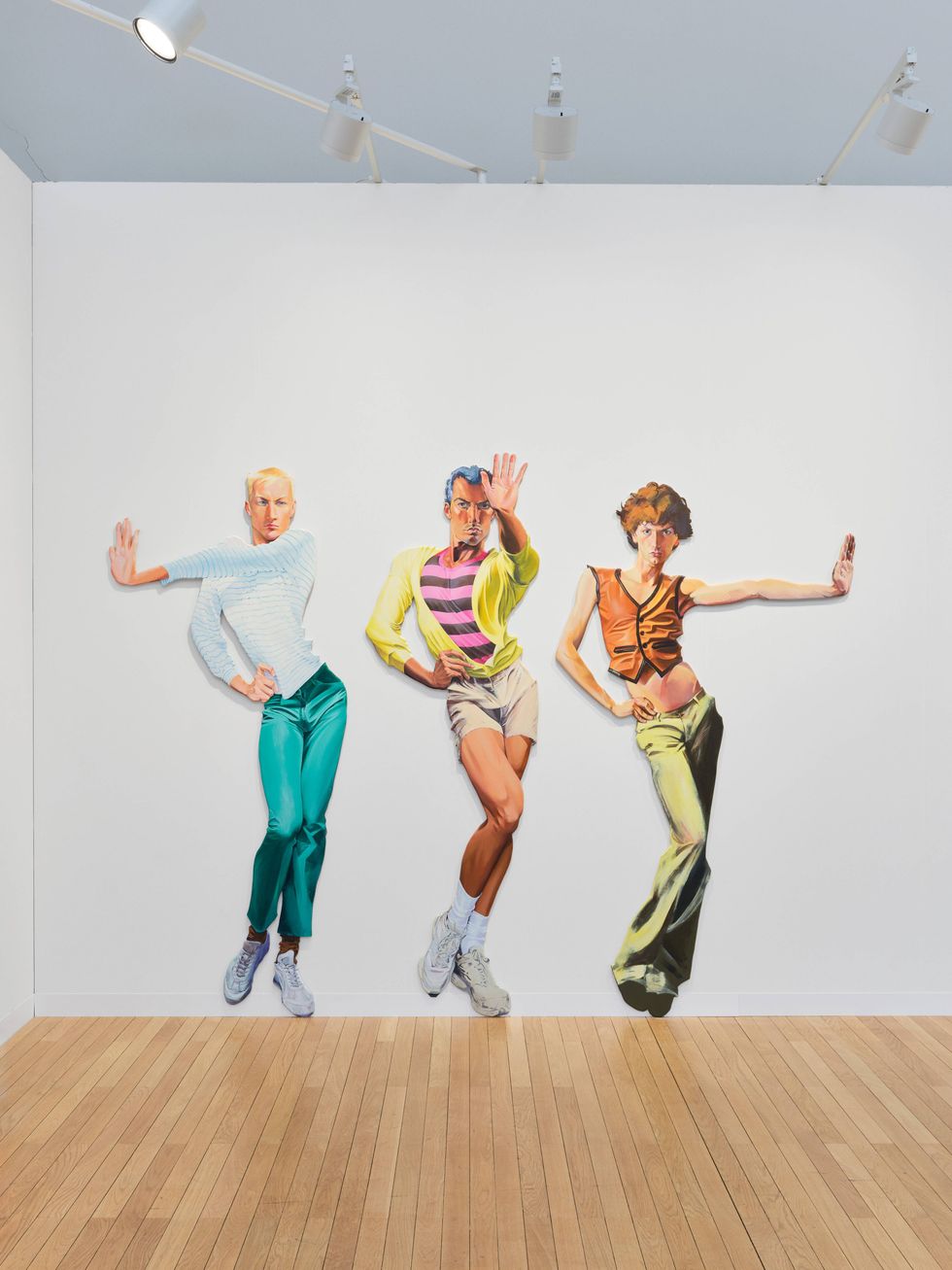
Installation view of Drake Carr at ArtBasel Paris
Photo: Choreo
Courtesy of Mariposa Gallery
However, although usually an upbeat week full of a combination of fashion and art events, this year's Art Basel had a decidedly more somber atmosphere. Nationwide protests had come to a head on the streets of Paris just days before the fair opened, as students and young people across the city protested poor education funding, crumbling infrastructure, and a steadily rising cost of living amid a deflated job market. Evidence of a weekend of mayhem was everywhere: luxury stores were boarded up, police presence was ubiquitous, and helicopters swirled overhead at night, enforcing curfews in what authorities viewed as "high-risk" neighborhoods. Listening to collectors and gallerists moan about how difficult it was to navigate traffic on their way to five-star hotels on the Champs-Elysées was somewhat dystopian, to say the least.
However, in the face of political unrest, art shines brightest. For me, spending the week looking at art served as a reminder that art is not just a luxury commodity, but also a political statement in and of itself, and is often best viewed through the lens of public unrest. On the Sunday before the fair opened, the Musée D'Orsay opened its Jenny Holzer show J'AI VU; as an artist whose work heavily focuses on the written word, this show is one of Holzer's most ambitious yet, drawing upon over 750 texts from 73 different authors. The texts themselves include musings about labor strikes, anarchy, war, class divides, political corruption, and a general dissatisfaction with the world around them. "I think of the future and see it so dark, so dark that I shrink back terrified," says Emile Zola. "One must seize the reality of one's fate," is another quote from Van Gogh. In a city at odds with itself, Holzer's words hit close to home.
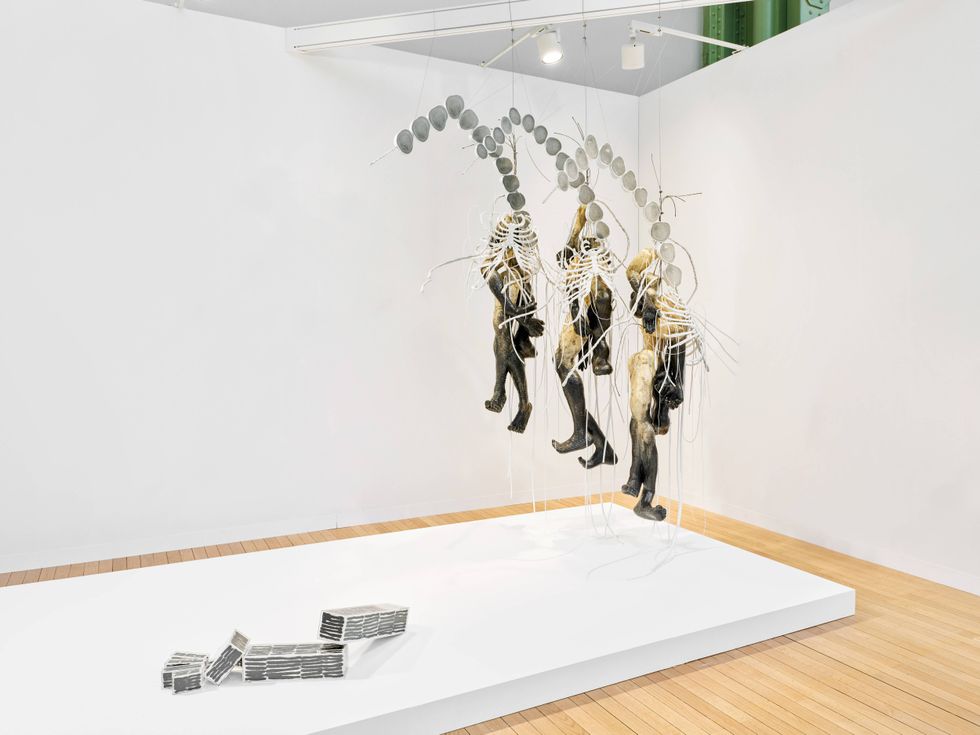
Haneyl Choi, Art Basel Paris 2026 Installation View. Photo courtesy of P21 Gallery.
Beginning on Tuesday afternoon, the Grand Palais opened its doors to top clientele, and the floor beneath the building's famed glass dome quickly filled with art critics and buyers alike. Upstairs, in Art Basel's Emergence section (dedicated to solo presentations by emerging artists and galleries), Haneyl Choi's installation immediately grabbed my attention. An arch of disembodied legs and arms was suspended from the ceiling, framed by ribcages that dripped with white, tubular entrails. The description of In a Falling Dream sounds like a hallucination, yet the sculpture held a kind of somber fragility despite its graphic appearance. Choi's work freezes the moment when body and mind separate; his sculpture seeks to encapsulate the sensation of falling that people often experience just before falling asleep. There was something deeply unsettling, yet beautiful, about witnessing the body pulled apart while suspended between agency and helplessness. Notably, downstairs on the main floor, Tina Kim Gallery's booth featured sculptures by Choi's friend and fellow artist Mire Lee, from her Endless House series. Similarly graphic, Lee's sculptures resembled intestines pulled out to dry and molded into hollow, egg-like shapes. As the series title suggests, Lee draws a parallel between the human body and the house, both understood as vessels that shelter and protect the human spirit. The transformation of organic, flesh-like forms into structures resembling architectural scaffolding underscores this relationship, blurring the boundaries between bodies and buildings, while calling into question themes of human mortality and permanence.
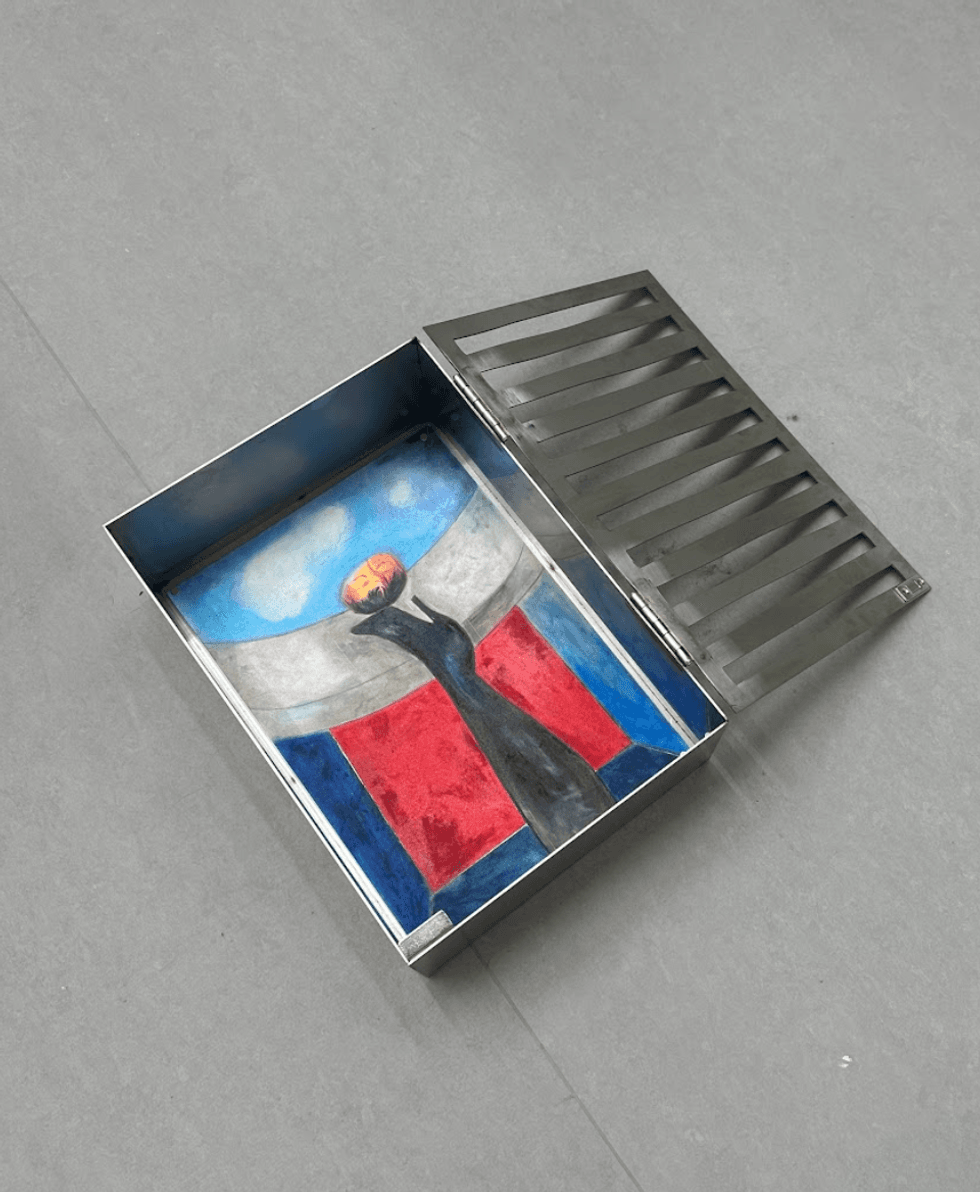
Tarek Lakhrissi VELVET SERIES (II), 2026, Oil pastel, coloured pencil and soft pastel on paper, stainless steel. Photo by Elizabeth Chung
Down the hall from Choi's work in Emergence, Drake Carr's flamboyant figures offered a diametric opposite, posing with exaggerated swagger in ways reminiscent of queer ballroom sashays. Displayed as larger-than-life cutouts, Carr's characters had their chests bared and were clad in boldly colorful garments, featuring exaggerated shoulder pads and low waistlines. Their unapologetic playfulness felt almost subversive against the studied seriousness of Paris' fashionable crowd. Drawing on his own experience bartending at Happyfun Hideaway, a gay tiki bar in Bushwick, Carr reimagined the bar as a kind of sacred space for observation, flirtation, and self-presentation. Around the corner from the Emergence section, inside gallery Seventeen and Nicoletti’s shared booth, artist Tarek Lakhrissi similarly mythologized queer space, albeit with a decidedly darker twist. Paintings depicting S&M scenes - a man bound in rope, a fetishistic, leather-clad leg - are imprisoned inside metal cages, forcing viewers to squint through the bars for a glimpse. It remained unclear whether these cages are meant to contain supposedly deviant desires, or shield them from the prying eyes of the outside world. Meanwhile, in Semiose Gallery's booth, Xie Lei's purple figures swirl and meld against one another like flames in the dark, creating a space where homosexual love is always ephemeral and never quite within reach. One might wonder if I am heavily biased toward queer art- I admit, possibly! But these were genuinely the works that caught my attention among a sea of high-quality booths. Perhaps it was their irreverence, and their willingness to be strange.
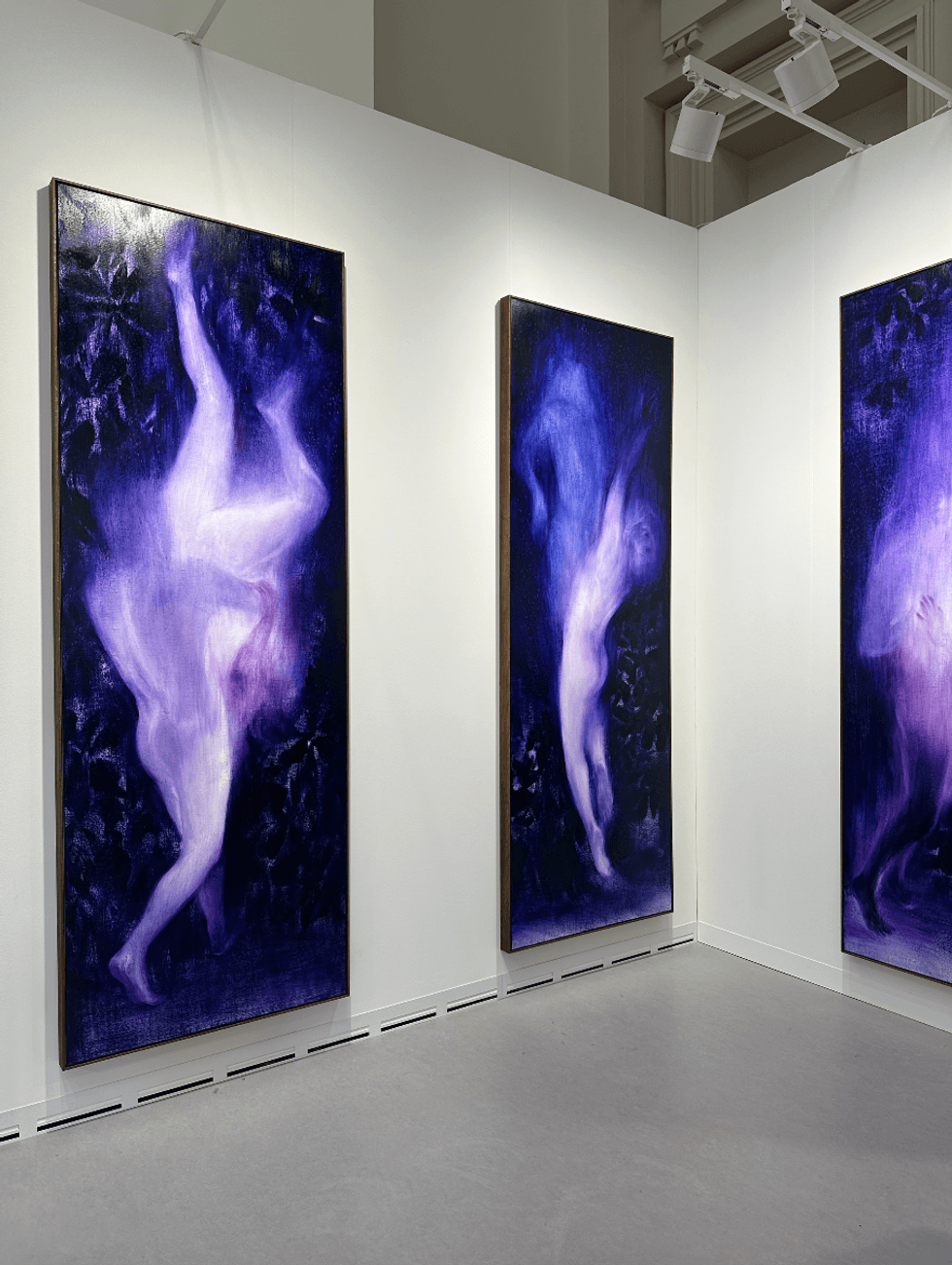
Xie Lei, Admiration Series, 2026. Photo by Elizabeth Chung
On Thursday, the first public day of the fair, gallerists were beginning to mutter amongst themselves. Word had spread that more student protests were scheduled to take place directly in front of the Grand Palais over the weekend. Would the art be safe? Would people even come to the fair? It was hard to imagine art enthusiasts elbowing past protesters and police forces just to see some paintings. Moreover, given the destruction of the weekend before, some were even speculating that protesters might try to enter the fair and damage the works. In the end, none of these scenes came to pass; to gasps of surprise, on Thursday afternoon it was announced via email that ArtBasel would close two days early. An untimely end to an already unusual fair, and perhaps an unexpected reminder that, no matter how much the art world might like to insulate itself, it can never quite exist outside the world around it.