Gillian Anderson Can Haunt Us Anytime
Story by Sam Bodrojan / Photography by Yana Van Nuffel

I woke Gillian Anderson up from a nap.
The first thing she offers upon joining the video call is an apology: “I must’ve…drifted off…I saw my son napping and thought to do the same.” She speaks in lucid terms and a relaxed cadence. By the angle of her camera, one can tell she is in her home, but not what room, or where the sun was.
There PAPER was, interviewing someone who could speak to a journalist moments after being unconscious, without breaking a sweat.
The nap is justified; it’s a busy time for Anderson. She’s on the West End this fall opposite Billy Crudup in a production of Who’s Afraid of Virginia Woolf? Next month, she’ll publish More, the follow-up to Want, a collection of anonymous sexual fantasies from women across the globe. Arguably most notable, though, is her instantly-iconic turn as Billy Presley in Jane Schoenbrun’s Teenage Sex and Death at Camp Miasma, out on August 7th. A goofy, sexy meta-horror film, Camp Miasma is an achingly personal, chaotically entertaining deep-dive into sexual dissociation, the objectification of queer artists under capitalism and the self-destructive urge to politicize one’s own desire.
Former PAPER Coolest Person Hannah Einbinder plays Kris, a budding director tasked with helming the woke reboot for a transphobic ‘80s slasher series (a la Sleepaway Camp). While researching the project, she tracks down the original film’s final girl—Anderson’s glamorous, kooky starlet: Billy Presley.
Billy dresses like an old Hollywood icon, all big hats and sparkling fabrics. She goads Kris into smoking weed, flirts with her by sensually lowering finger-shaped fried chicken into various dipping sauces, delicately nudges her to open up about various sexual hang-ups.
Though the film namechecks Sunset Blvd., Billy Presley’s charms are harder to pin down. The closest we’ve come is, “secret third sister in Grey Gardens whose thing is that she’s horny.” Billy may be odd and unreachable, but Anderson’s presence is an immediate and universal pleasure. Her performance is the tonal north star for the film. The whole film clicks into place the second she lets out this disarming, goofy laugh.
There’s certainly a “meta” significance to the casting. Gillian Anderson has been, at this point, a formative crush for at least two generations of men and women alike, thanks to The X-Files, Sex Education, and Hannibal. Here, she is lover, therapist, mentor, diva, idol, angel—the perfect shepherd through a film so attuned to the psychoanalytic effect of media on sexual fantasy.
Throughout her conversation with PAPER, she is at once formidable, warm, thoughtful, at times vulnerable, ever-so-slightly aloof. In other words, Gillian Anderson is overwhelmingly glamorous.
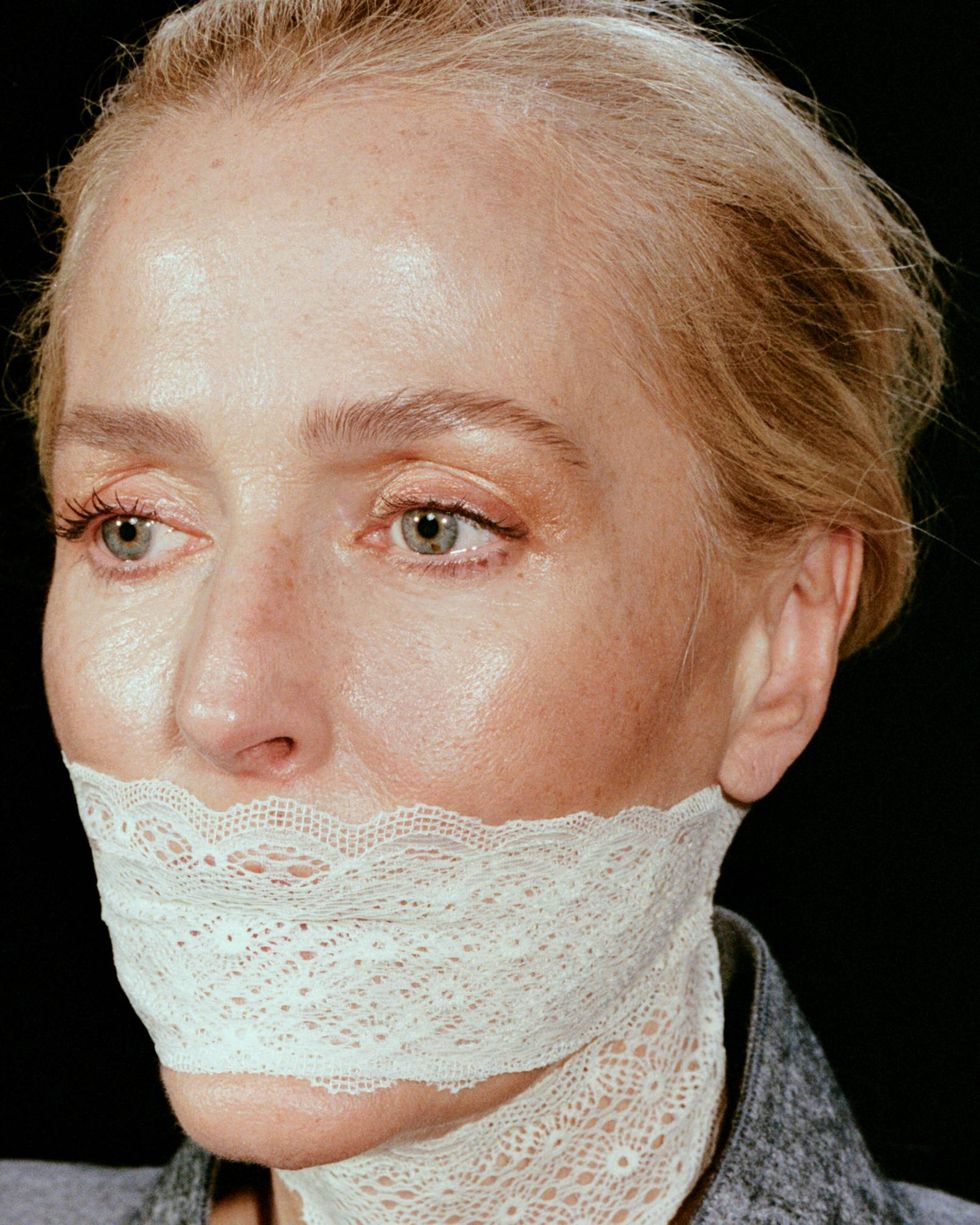
Jacket: Alexander McQueen, Mask: Stylist's own
First of all, I love the film, and I love your performance in the film.
Well, thank you.
I promise I’m saying this in earnest, not just to be sycophantic.
Well, double thank you then [laughs]
What drew you to Camp Miasma? How did you get involved with the project?
It was kind of the normal way that it happens, which is that an agent sends a script. It was prefaced by a very gushing email from a particular agent. He’s at UTA, based out of New York, and he is very up on the best and coolest filmmakers. He is often sending me links to great indies that he's seen, and I've come to really trust his taste and his opinion. He had said, “This is something special.” So I paid extra attention to it. I'd already seen TV Glow. I read the script and I found it impressive. If you're familiar with Jane's work, you could tell on the page what they were aiming for. We had a really long Zoom, Jane and I. I felt really, really comfortable talking to them. I mean, they’re so knowledgeable about everything - film-wise, music-wise. Somehow, they felt very familiar, and I thought, oh my gosh, I want to be a part of their world.
They chose to shoot on Vancouver Island, and I know that part of the world very well. The first five years of X-Files were in Vancouver, and then my daughter was born in Vancouver; I've had a tiny place on one of the islands for a very long time. It's a part of the world that I go back to, and so that also made it extra special. That part of the world is very… I don't want to get too… esoteric, but, it's just…it's deep. It's got deep history.
Who were some personal references when developing this character? I was struck by Billy’s very particular accent, this cross between transatlantic and Southern.
I never quite know how to talk about where stuff comes from, you know what I mean? A lot of it is more intuition than anything. It comes from the ethers. Like, Billy's voice: That's just how she was in my head! It’s like she already existed out there, and I was just clawing through the forest to see what she was like. Like, oh, I think that’s how she speaks. Same with the eye makeup, with Twiggy's eyes; when it appears, it either feels right or it feels wrong.
That makes it sound so much more random and haphazard, which it doesn't feel like it is. Fortunately, Jane, the hair and makeup team, were completely open to all of it. Kendra [Terpenning], the costume designer, just pulled some amazing items: the turbin, the scarves, the flowing robes.
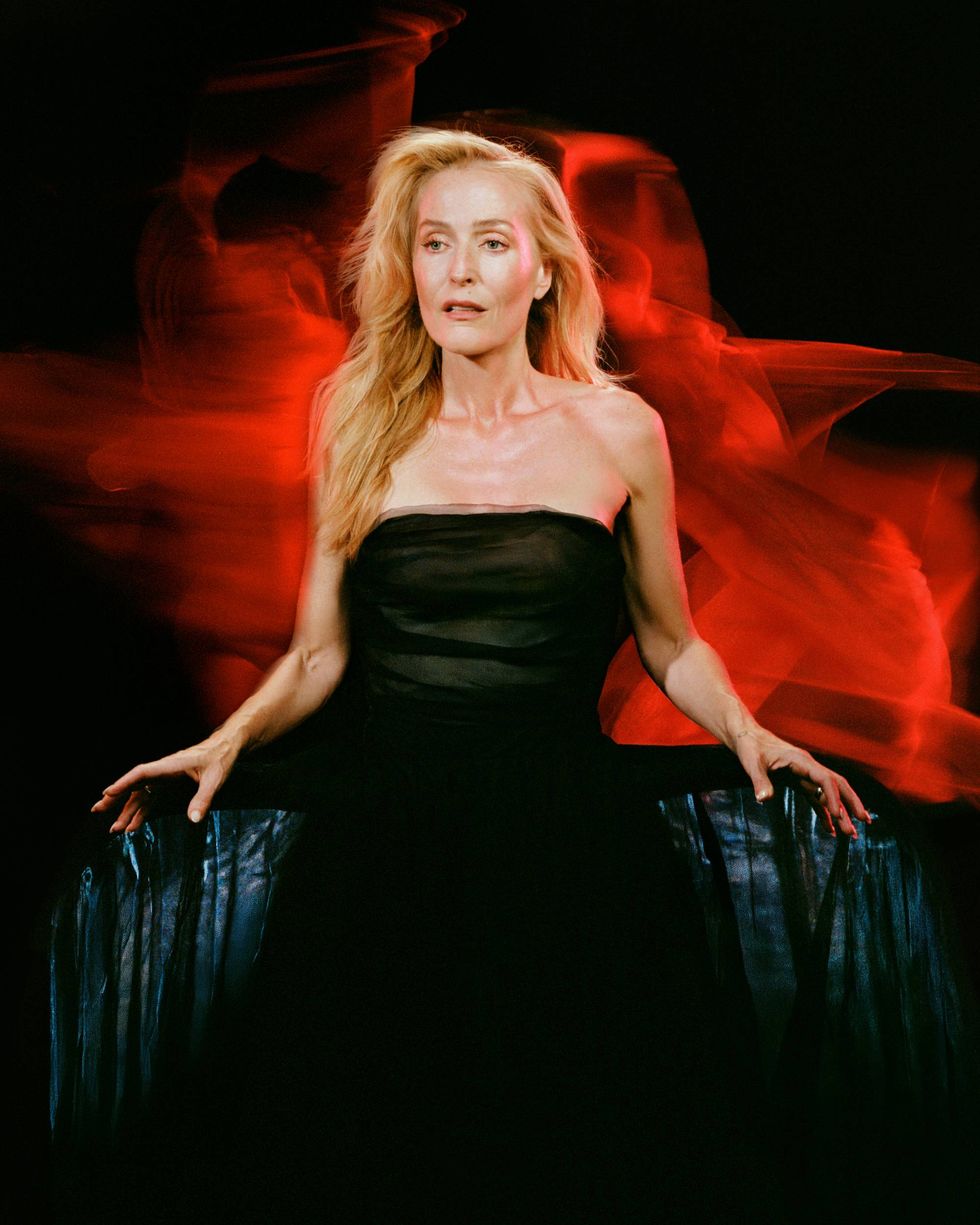
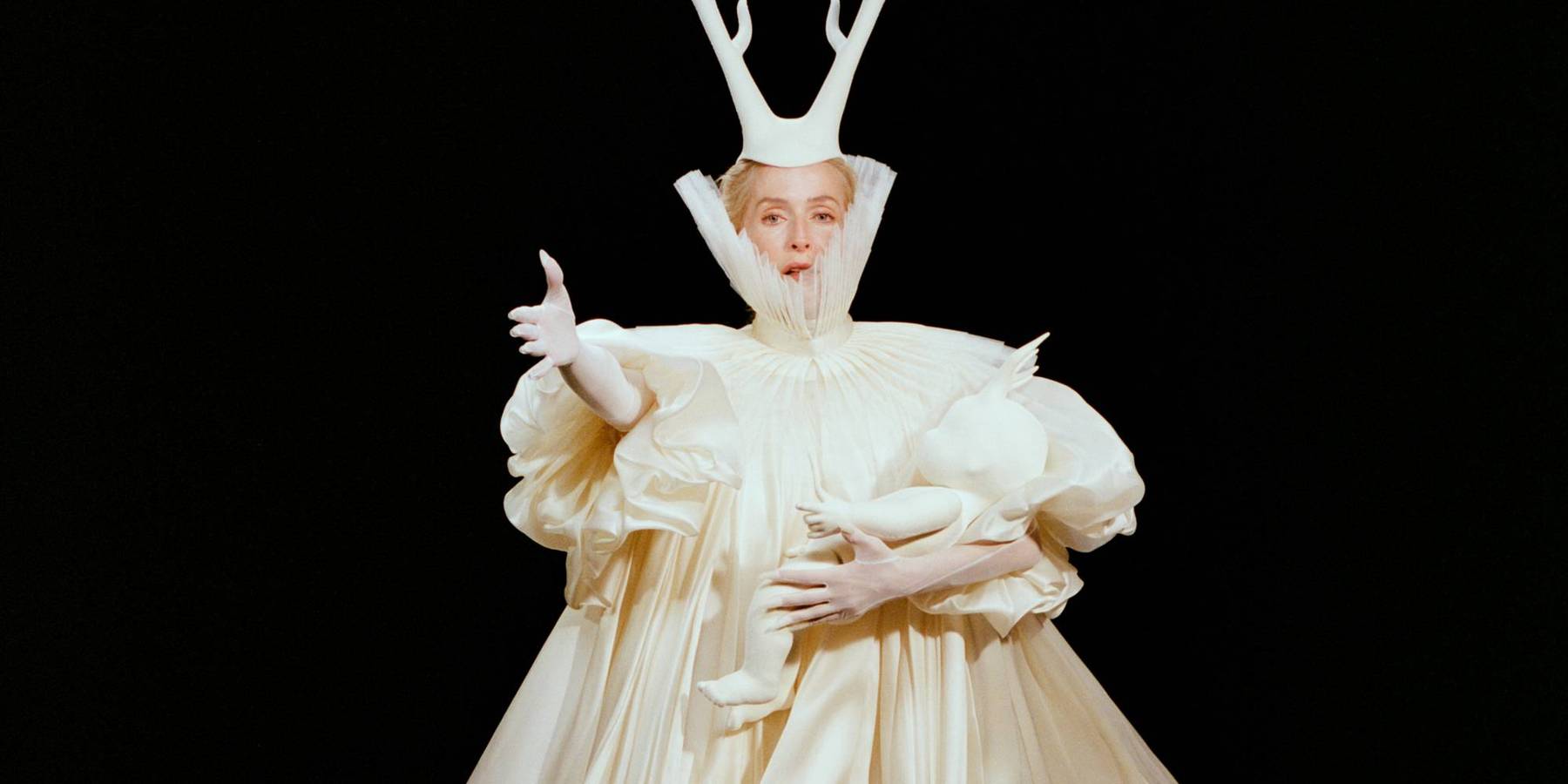
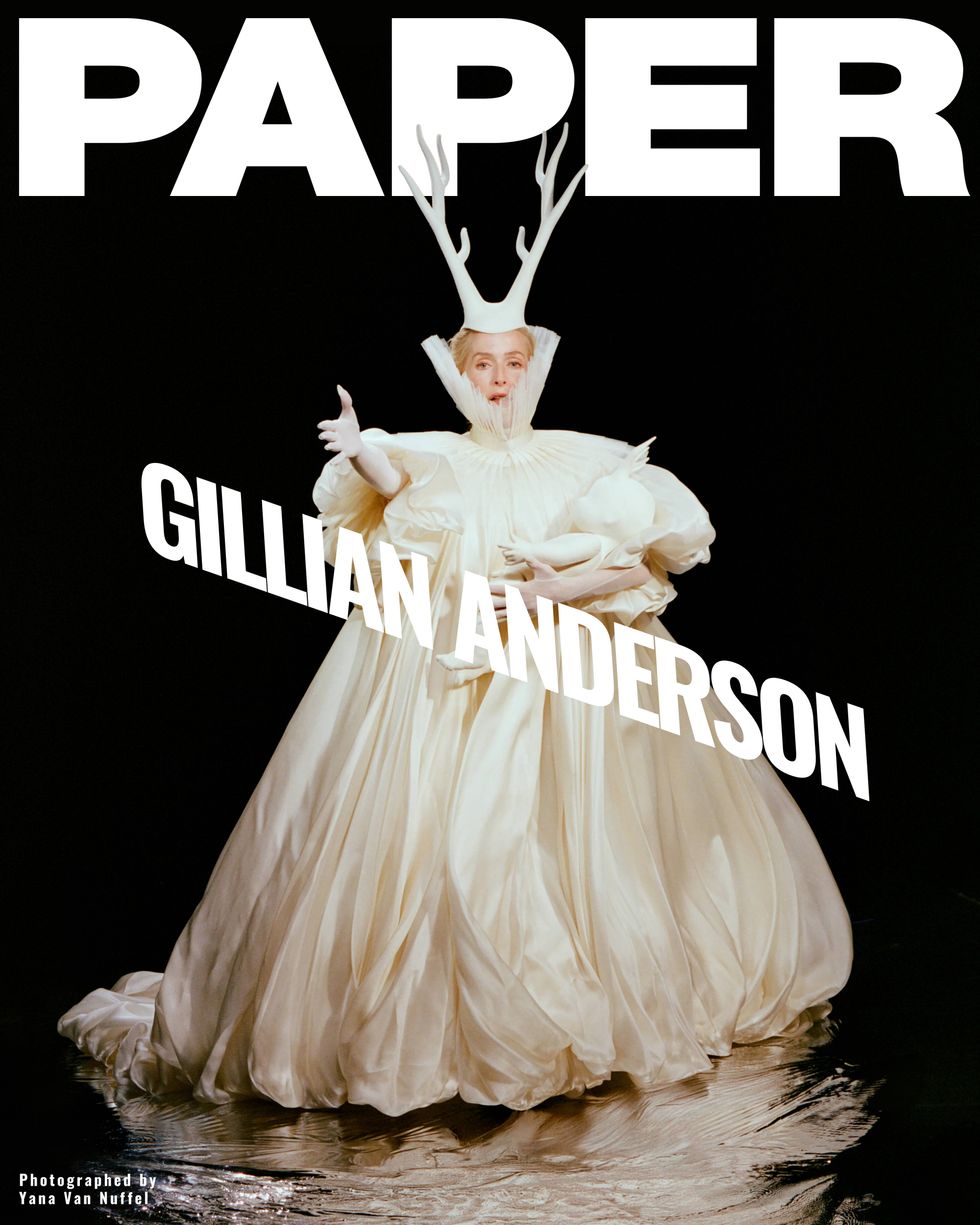
Full look: Boloria, Rings: Cartier
Billy Presley is a Hollywood starlet, a witchy recluse, a sort of vixen. It’s clear what Kris sees in her. What do you think she sees in Kris?
That's a good question. I think she's intrigued by her, obviously. She's never quite seen anyone quite like her. When she first shows up and delivers this diatribe about film and gender and the industry…you know, I think Billy's quite naive, quite innocent. So she's overwhelmed by the big personality that is suddenly sitting in her sacred space. But I think she really feels for her. She’s compassionate towards her, and Kris's intention and her struggle. She wants to help, even though I don’t think she gets it yet, from the beginning. She wants to help Kris’ dream come true.
Then obviously everything takes a turn when Kris seduces her. From that point on, she realizes what they can both give each other. She knows what she wants to give Kris, and I think at the same time, what she’s receiving. She just lets go into it. And they fall in love.
It's interesting that you say that Kris seduces her. I think back now on that scene where Kris walks out topless and it’s like, of course Kris is the one who seduced Billy. Yet until this moment, as we’re talking, I had read it as the inverse.
It was important to me, when we were filming it—you know, the chicken, the dipping sauce, I know all of that would play as Billy doing the seduction. So it was important for me to counterbalance that by playing it very innocently. I wanted it to feel like it was the other way around. I didn't want to be creepy. I didn't want to be predatory.
It was also important that I didn't play her too maternal, that when they come together, they're on equal standing. I think that all worked out that way, but there was a lot of deliberate intention there in how it was played. There was so much that I didn’t want it to be.
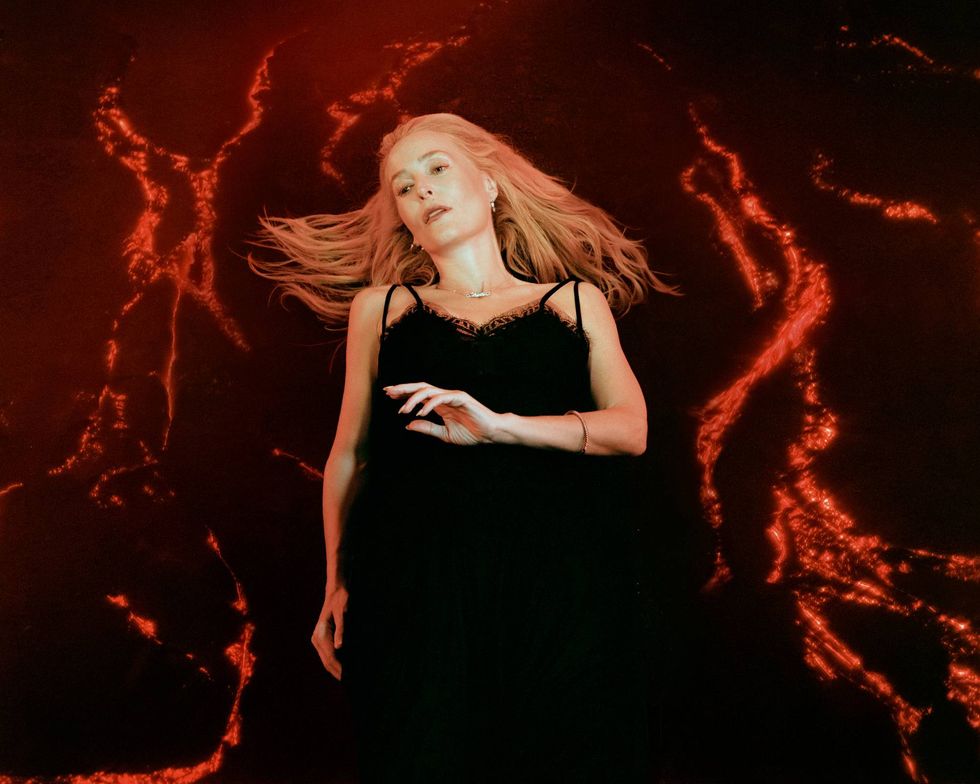
Dress: Fendi, Jewelry: Cartier
It’s sort of a prismatic relationship, where their dynamic can be understood along six different axes. It’s one of the ways I feel Camp Miasma is deeply in conversation with fan culture. You’re no strangers to conventions and to media that people project onto a lot. How do you navigate that as an artist? As a private individual?
I'm very good at compartmentalizing. I don't have much of a relationship to it in my private life. When I dip into it, it feels intentional. There’s a real negotiation that happens. I don't understand fandom as something I might’ve experienced myself. But I understand why it exists, how important it is for some people. I also understand my place in it, that because of what I’ve done, the Scully effect, my part of the relationship is important. It feels necessary from time to time to engage in that space. There’s something that almost feels like being of service. Not that it’s charity, but it’s part of the negotiation, where I almost get to say, “Thank you for your support.”
It costs a lot, too, being in that environment. Conventions are fucking exhausting. You feel like your life-force is being…I don’t want to say sucked out, because that’s not right, but it’s intense.
You have these beautiful, compartmentalized relationships with strangers, this very grounded experience, but then there’s this massive event that can feel dehumanizing for everyone involved.
It is! It can be very dehumanizing, both for the people who are fans, and the star. So to have a grounded, one-on-one connection, to make eye contact with someone, that can have a lot of value for both sides.
Did any of that crop up when you were exploring Billy?
That showed up more in the opposite part of me. I can be quite reclusive and isolated. There’s a part of me that does not like a lot of people, that likes to hide. I’m a bit of a hermit. My happy place is usually where it's quiet and there's nobody anywhere. I identified with that part of Billy.
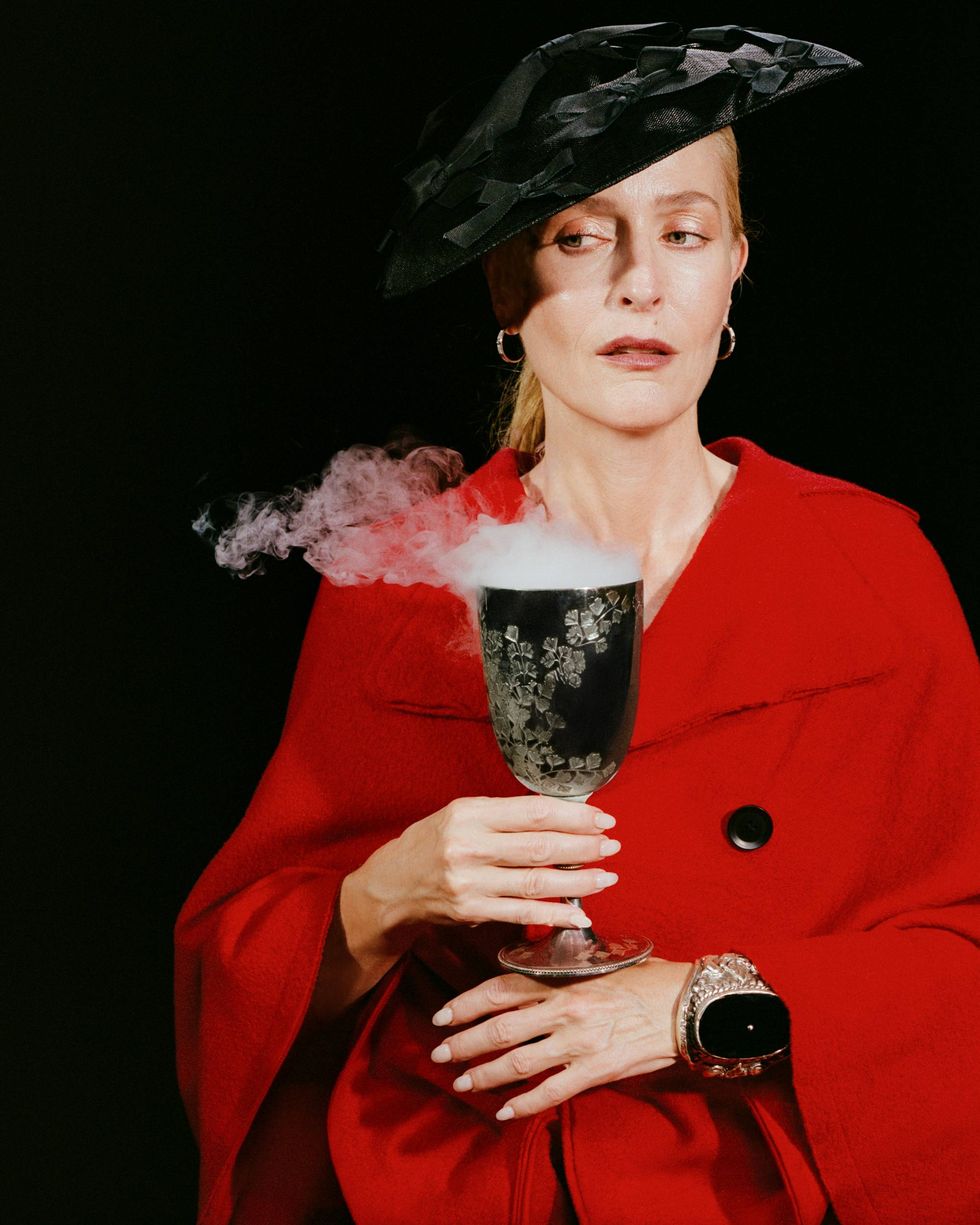
Hat: Stephen Jones Millinery, Earrings: Cartier Coat: Yohji Yamamotro from 20 Age Archive, Bracelet: Yves Saint Laurwnt from Pyrn Archives
Across your career, every few years you’ve returned to the theater. I think there’s something very chic about the fact that you have been on every screen I’ve ever owned, and yet you continue to pursue this thing where you perform each night for, at most, a couple hundred people.
It's true. I actually start on Monday rehearsing. The next theater adventure. It is something I only do every three or four years. It’s important to me, but at the same time, whenever I'm about to jump into it, I always think, what the fuck am I doing? Why am I doing this to myself again? I don't know what the answer is yet. I always am grateful for it by the end of it. No doubt that will happen again, but at this juncture, it's still a moment where I can’t quite believe I’ve said yes. But it's good for the soul, and it's hard. That’s where I feel really challenged.
What feels challenging about it?
Well, physically. Doing eight shows a week, particularly if it's something like Streetcar or Who’s Afraid of Virginia Woolf? That’s seven hours on-stage, two days a week, plus the normal days. It takes a lot of stamina. These runs are long, and you have to continue finding meaning in each show, so that it stays alive and doesn’t become rote. You obviously can't change the dialogue, but when you do a different reading, or you move somewhere different on stage, or you pick up something at a different time, those things kind of scare the system. It reminds you that there’s an audience out there, that you’re walking on a tightrope. It's like nothing else, and it feels scary.
I was reading through Want and More. I was struck by how vulnerable these women are about their sexuality. This is something you certainly haven’t shied away from across your career. How do you navigate being such a sexually outspoken figure in the public eye?
It has been important to figure out the right perspective, the right amount of… personal reveal. I confine most of my remarks to characters I have played. So I’m not really talking from a personal standpoint. I knew that, were I to talk about my own experience, that would be the headline. The book’s not about me; it’s about all the women who contributed. I’ve tried to remind journalists of that as much as possible, to refocus on the individual women who were courageous enough to write their fantasies down and send them off to a stranger and potentially hundreds of thousands of people.
Because I was asking women to bare themselves, it felt really important for me to write my own, submit my own, which I did for both books. It was also important that I get the same level of anonymity that the women who submitted did.
There were only a couple of submissions from women of my age, who were either American or British and white, which surprised me. We ended up scrambling the little details at the end, because if we didn’t, it would be very obvious which was mine.
I would never have guessed that this would be such a big part of my life. I have found myself here through tiny, tiny steps. It all starts with Sex Education. When it was suggested to me that I do almost like a modern-day version of Nancy Friday's My Secret Garden, that made perfect sense. Who knew that it was gonna be such a hit? I wouldn't have guessed that there was still such a need, particularly for women, to be able to express themselves, for a very public discourse to take place around desire. By asking oneself questions about whether one is fulfilled, it very quickly leads to a bigger question about whether one asks for what one wants in life, period.
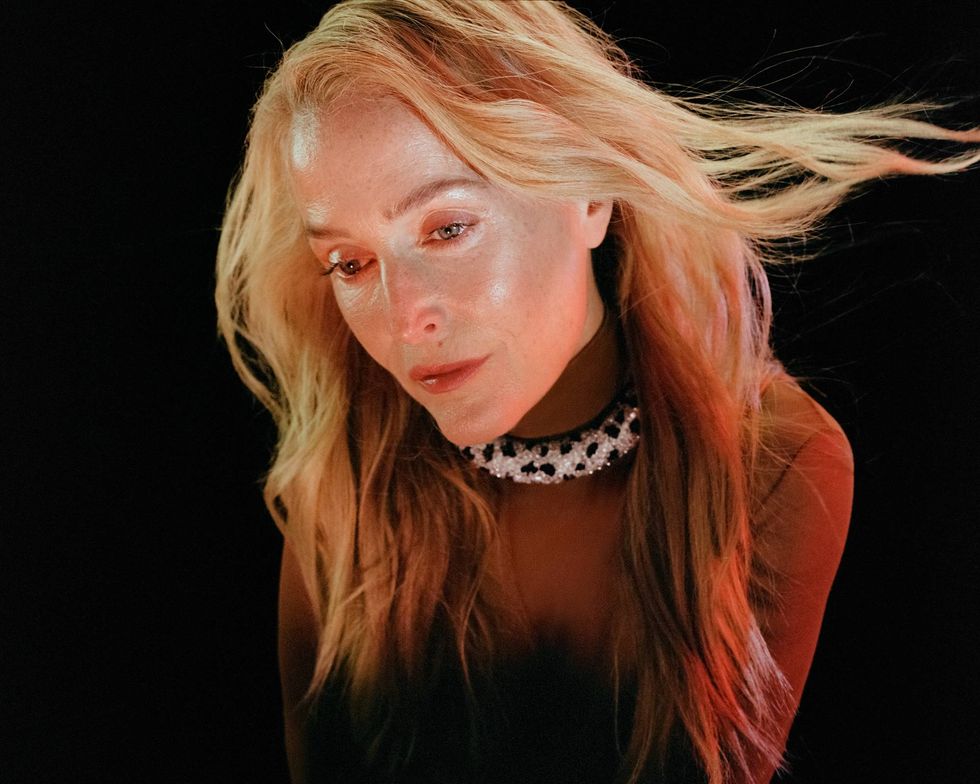
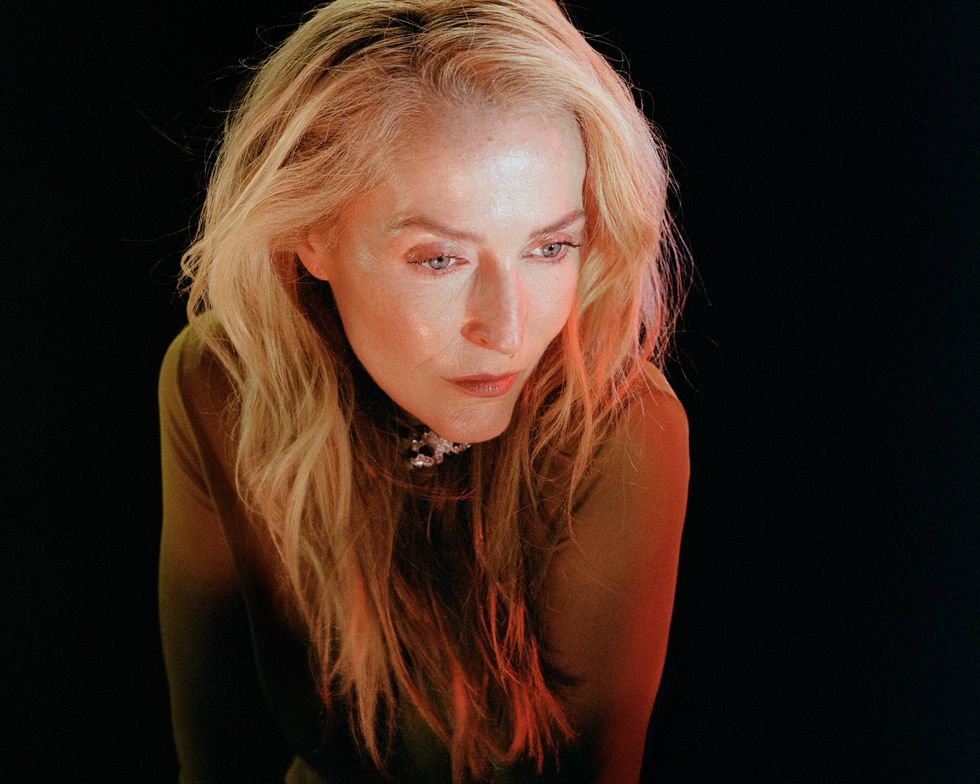
Dress: Diego Ortega, Choker: Vintage Balenciaga from Pyrn Archives
It's something I see explored in your performances and in your characters throughout your career. The first thing I ever saw you in was Terence Davies’ House of Mirth, as Lily Bart. That’s a woman destroyed by these external pressures to politicize her desires. And then with Sex Education and Camp Miasma, you have these characters who are giving permission to younger generations, to themselves, to become open and unashamed of their needs. Do you feel this is a conscious throughline in your art, or just something you’ve naturally found yourself drawn to over the years?
I don't believe it was conscious. I've played a mixture of women who have already found their voice, and who are very empowered within it, whether it’s Jean or Stella Gibson. They are very articulate in their beliefs, their sense of self. But it’s been important for me, from time to time, to play women who really struggle, like Blanche or Lily Bart. These are women who don't have it all figured out. It’s all part of the same conversation, really. I feel there is a greater need than ever to remind women or the queer community, those on the outskirts of society these days, how important it is to not let yourself be diminished.
You specifically have offered a lot of support for trans people at a time where I think, like, in both England and in America we have been politicized as a group to our detriment, and subsequently abandoned. Why is supporting us so important to you?
I feel like I understand the tragedy of the whole situation in a very visceral way. I feel a lot of compassion for any faction of society that’s just gotten kicked from all sides. I've known a few people in the trans community in my life, and I've experienced the pain, and the heartbreak, and the confusion, and the self-hatred, and the transformation, and the joy. I know that it feels like life and death to some trans people, you know, whether or not they are able to live as themselves, or as they would wish to live. It’s not even, as I understand it, about being accepted. Feeling that one has a right to live however one chooses to live, and identify however one chooses to identify—it's quite simple, actually.
Photography: Yana Van Nuffel
Story: Sam Bodrojan
Styling: Nina Cheb-Terrab
Makeup Artist: Amanda Grossman
Hair Artist: Paul Jones
Set Design: Allegra Peyton
Digital Op: Hristo Hristov
Lighting Assistant: Kenneth Liew
Stylist Assistants: Molly Mansfield & Aurore Petetin
Production: A&R Creative Production
CREATIVE & EDITORIAL
Head of Creative: Brian Calle
Editor-in-Chief: Jordan Bradfield
Fashion Director: Angelina Cantú
Editorial Director: Mickey Boardman
Digital Director: César Alvarez
Digital Director, PAPER Español: Ricardo Diaz
Social Editor: Alaska Riley
Jr. Creative Director: Peter Demas
Editorial Manager: Tamara Amhaz
LEADERSHIP & PARTNERSHIPS
President: Jason Ve
VP of Brand Partnerships: Jamie Granoff
Director, Brand Partnerships: Araceli Franco
Senior Creative Strategist: Aires Amor
Senior Creative Strategist: Jordyn Albritton
PRODUCTION
Chief Operation Officer: Erin Domash
Executive Producer: Aya Sloan
Jr. Producer: Melina Brown
Design Team: Composite Co.
Jr. Graphic Designer: Aviance Whitman
Jr. Graphic Designer: Gabe Walsh