It's recently come to my attention that I love messy gay people. I also love Drew Droege, although that's no secret for anyone clued into the genius behind the biting, "pitch black" new satire Messy White Gays.
The playwright and star calls me from the park just days before the holiday, house packed with people and a fresh chill in the air. I'm still shivering from the jokes I'd seen the night before, when I sat with my hands over my mouth for much of his new play's second half. Murder, cocaine and rosé make for quite the comedic smorgasbord — that's all before Droege walks onstage, after which he proceeds to be the deliciously hateful middle aged gay guy I make up in my brain every time I'm at drag brunch.
It's a play unlike any I've seen in recent years, and likely won't again when it leaves. That's just how sharp his pen is — it leaves a mark that could kill.
Now that critics and audiences alike have digested much of its early run, Droege is well aware that the material — which concerns a murderous pair of messy white gays and their cabal of self-obsessed Manhattanites — is off-putting to some. "It's a pitch black satire and we are playing terrible people, and I think it's just hard for people to wrap their heads around: Oh, is this show in on the joke? We would love people to know: We absolutely know that we're playing horrible, nightmare monster people, but we are having so much fun." Droege jokes that well-meaning audiences some nights seem visibly mixed up over whether it's ok to laugh at all. "When you get the drunk gay crowd, they know we can laugh at ourselves in a way that maybe straight people are like, Oh, I don't know. My child is queer or my friend is gay and I don't know if can I laugh at this? I don't want to look like I'm on the wrong side of history or whatever."
I was thankfully sat in a crowd of seasoned New York City queer people, who laughed at the broad strokes comedy about Grindr as well as the more specific nuances of open relationships and the unfortunate closing of Hell's Kitchen fixture 44 & X. It's the exact blend that made Droege just a cult favorite amongst the cohort, raised as I was on his eternally funny impressions of Chloë Sevigny on YouTube. "I grew up in a small town in North Carolina and I was just enamored with New York culture, like Downtown, indie, everything that Chloë Sevigny is. So cool and edgy and weird and alt, and it was everything that I just looked up to."
That alchemical cocktail of cutting gay satire and specificity extends to his cast mates onstage, working through material only someone of his comedic prowess could possibly hope to achieve. Droege tells me that he "didn't want to write any character who was going to be MAGA or use slurs. That was too easy. Of course we hate that. What are our problems with liberals and with people who think they're on the right side and they think they understand?"
Alongside vets like James Cusati-Moyer and Aaron Jackson are Derek Chadwick and Droege's comedic foil, Pete Zias. I was familiar with the Instagram Live iconoclast from his weekly show, TOTAL TRASH LIVE!, which features more berets and magnifying glasses than I'd know what to do with. "Pete is the funniest person I know. We've been best friends, and we've known each other for 20 years almost." Droege says that when he originally wrote Zias' character Thacker, "I really thought, in my mind, it was going to be a 25 year old chorus twink."
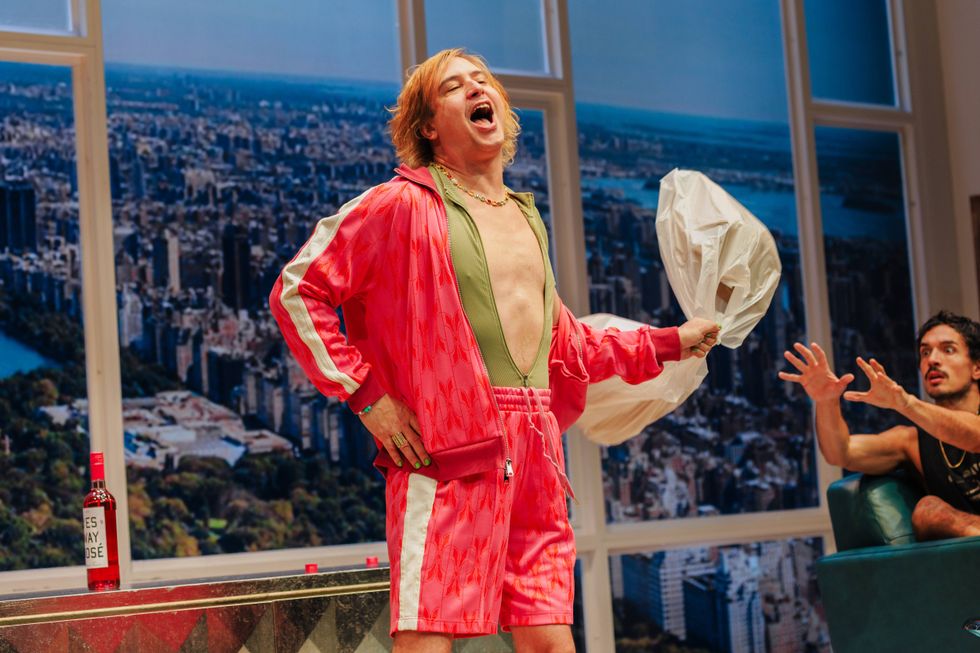
Coke-addled, cantankerous and clad in a pink tracksuit, Droege jokes that "we don't see that character a lot in gay representation yet. We all know that person, and I think a lot of us are afraid maybe of representing that and being like, Oh, is this offensive or stereotypical? Pete plays it with such honesty." One memorable monologue anchors the show's later half, in which Thacker runs onstage under the influence of some freshly acquired substances, shaken up by an encounter with an elevator and some tourists. For Droege, it was the easiest bit to write in all of Messy White Gays. "When you have that inspiration, I've learned now to go write it, put it down somewhere, make a note, use it later. You have to jump on board, because the easy is the good sign."
For more on Droege and the messiest white gays off-Broadway, read his full conversation with PAPER below. This interview has been edited and condensed.
How are you feeling now that Messy White Gays has been out in the world and audiences have seen it?
It's a blast. I've never done a show that has such wildly different reactions from crowds every single night, so it keeps us on our toes. We really have no idea some nights. I mean, it usually goes well, but some nights they sit there in silence and then we get a really lovely response at the end. They're just sort of taking it in. Other nights, they're laughing from the beginning. It's a pitch black satire and we are playing terrible people, and I think it's just hard for people to wrap their heads around: Oh, is this show in on the joke? We would love people to know: We absolutely know that we're playing horrible, nightmare monster people, but we are having so much fun.
I'm sure the reaction to it probably depends on if you get the, let's say, typical Broadway audience versus a room full of gay people.
Fully, and it's also in a small theater, it takes one or two people to laugh really loud to give everybody else permission to laugh. A lot of people have their mouths covered. Sometimes it just takes somebody to give them the bravery to go, oh, we can laugh at this. And yes, when you get the drunk gay crowd, they know we can laugh at ourselves in a way that maybe straight people are like, oh, I don't know. My child is queer or my friend is gay and I don't know if can I laugh at this? I don't want to look like I'm on the wrong side of history or whatever. So we want to just give people permission to feel your feelings, because we say terrible things and it's totally valid and fine to be like, oh my god, that was horrible. We're also prepared for that reaction too. It's fun.
Since we're lifelong friends, we've decided, I feel like I can be honest with you, Drew. I have been watching your YouTube videos since I was an evil little gay boy in high school. I'm not an evil little gay boy any more, but they were coming out while I was a senior in high school. And so I just want to say, from me to you, that you are probably responsible for every funny and also mean thing I've ever said about a celebrity on the internet.
Oh my god, that makes me so happy. Thank you.
Putting on your Chloë videos has become something of a party trick for me, no matter my age. The ironic coin skort from Obesity & Speed is just as funny the 400th time they've heard it.
Thank you, Joan. Thank you for saying that. That means a lot. It's wild, but you just put things out in the world and so many things just don't go anywhere, and then there's something that I did a long time ago, and I love that people remember it and still quote it and tell me about it. Very cool. It makes me feel good. Thank you.
I will never admit this in polite society, but I think you're the reason I knew who Tinsley Mortimer was in high school, living in Farmville, Nowhere.
I grew up in a small town in North Carolina and I was just enamored with New York culture, like Downtown, indie, everything that Chloë Sevigny is. So cool and edgy and weird and alt, and it was everything that I just looked up to, and I was like, oh, these DJs and these fashion people and food and cuisine and all of that is so not in my world. But I get a lot of people that love to talk to me about that stuff, and think that I know a lot more about it than I do, and I really don't know a lot about it. I'm just going to pretend to.
I work in a fashion magazine now, but back in the day I was like, if I talk that video, people are going to think I really know what's going on in New York.
I was just such a outsider looking in on that whole thing.
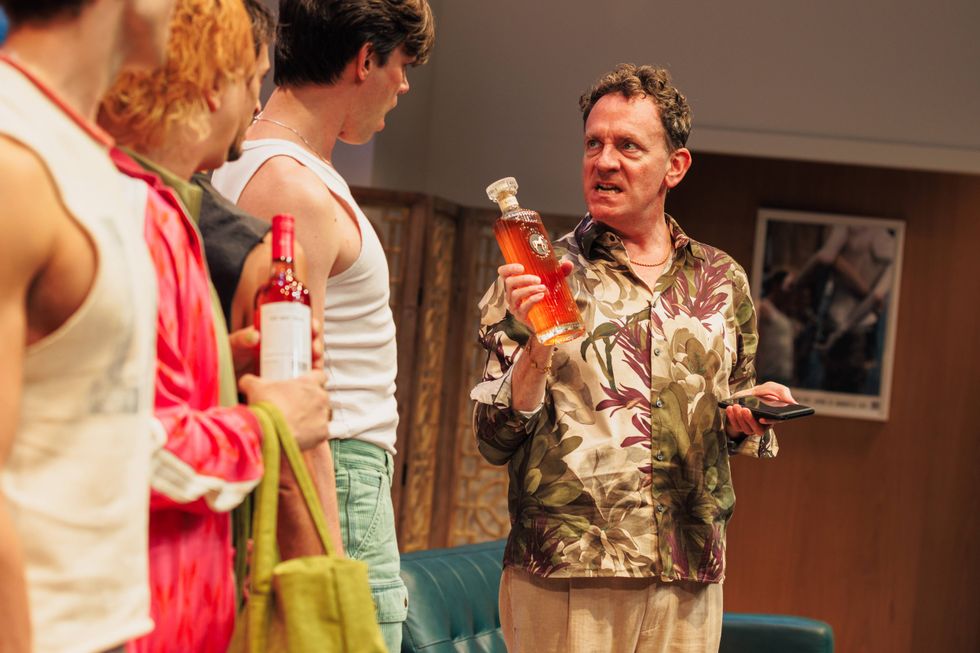
I caught the show this past weekend and I loved two things right off the bat. One, that you enter to applause. Two, you walk in and proceed to just be absolutely hateful for an hour. I mean, how fun is that?
It's so satisfying. It's so much fun. I love to write horrible people, and I genuinely don't think Chloë's horrible, I don't think at all, obviously, but even mine is. But a character like Carl, in this play... I literally have a character that calls him a cautionary tale. I write these people to be like, don't turn into this. Don't become this yet. I exercise my ability to just read people to filth on stage where it's comfortable and safe in a fun way. You meet every other character in the play before you meet my character. And so by the time you get to me, the audience has spent time with these people. and then this monster neighbor comes in and immediately is like boom, boom, boom, boom, boom. I see you, I read you.
I also wanted people to think that despite his horribleness, I wanted people to believe that he might be the moral center of the play until he absolutely is not. And I really wanted people to think that, oh, here's the playwright. He's not with them. He's a little bit older than them. He's going to come in and go, here's how you're all wrong and here's how to be a good gay. And I think Carl thinks he thinks that, but he's not. And I also just love the idea of being like: What if we are all messy? What if all white gay are part of the problem, myself included, and can we laugh at ourselves for 80 minutes?
It must feel like doing an exorcism, to allow yourself to play in that level of hatefulness. So much of media is good characters that we root for, and it must be fun to just be a completely horrible person on stage.
I try to be a good person in life and I want to be, but I just don't think it's honest when everyone's like: I want a likable character. What's likable? I also love flawed people. That's more human and that's more real. It does feel like an exorcism to get out there and do that, because also, we've done a lot of workshops on the play. We've had a lot of conversations about what we're saying, so I'm not just improvising. I wouldn't trust myself to just come out and do that because you do want to be sensitive and you can't really punch down. And we're saying a lot of things about race, and I want the joke to always be on white people.
We're able to get away with this because in my mind also, I grew up watching John Waters movies and Heathers. I knew the goal wasn't to be Mink Stole in one of those movies. The goal is to be Divine. I am tired of watching comedies where everyone's just so chummy and likable and good people and get along and wamp wamp — I made a little boo boo. It's dull to me, like, why are we spending time in the theater? I feel like the other side is making such horrible statements and they have no fucks left to give. They'll say whatever they want, so why can't we? I think we're very worried about hurting each other's feelings, which I think is a lovely quality in real life. But when we're on stage, I think it's important to make people go, whoa, can we say that?
A lot of media around gay culture can tend to be quite precious about older gay men, who lived through the '90s or even the "before times." It must be fun to subvert that expectation too, because you come in as an audience member thinking that character will be the moral center, have these quips and read the young kids down. Then, like you said, it turns out he's also a terrible person too.
I think Carl is older than I am, personally, and I'm 48. I've been alive during all of the AIDS crisis, but I am very careful not to claim to know what it was like. I don't firsthand know what that experience was like, but I do know someone who thinks they own all levels of oppression because they've had one in life. The amount of gay men that would say, Well, I understand what's going on with people of color or with trans people or with women because I'm gay. They might mean well, but they absolutely do not understand that experience.
I think there's an arrogance in that. I think there's also a rage in it, if you've been around for a long time, like: if you don't know a reference, at least want to know the reference, at least be curious as opposed to going, well, I wasn't around then. I don't need to know about that. But I think there's a danger in that as well, to sort of hoard over knowledge and to think that's intelligence. Just because you're older and know a reference, that doesn't make you smarter than someone who's younger and just doesn't know the reference you're talking about. So I think that's a very gay thing, that we sort of hoard information and we use it as currency against each other, but also to mask a lot of insecurity.
That's a good way of putting it.
I didn't want to write any character who was going to be MAGA or use slurs. That was too easy. Of course we hate that. What are our problems with liberals and with people who think they're on the right side and they think they understand? My character has a black husband, so he thinks he understands. It's like, do you fetishize that? Do you say that a lot at parties? That's fucked up. I know there have been criticisms of the play where people have said that I don't provide any answers, but I just laugh at that criticism. Like, how dare I provide answers? That's not my job. Maybe your job is to try to, but I'm just asking the questions. I just want to be like, Hey, look, this is the problem. But I'm not going to in 80 minutes — or even if the play was seven hours — I'm not going to give you answers on how to be a better person or how to change things.
I also think it's such a modern criticism to say art doesn't provide answers.
I guess because everyone has gotten so... "I me me mine." They're like, well, I didn't understand that because it wasn't my experience. It's sort of like the pendulum has to swing the other way eventually, and for you to go, oh, I'm observing these people and I can see similarities, or I can recognize this, but I don't need "And the moral of the story is..."
It's like a children's story then.
Yes, it's Aesop's Fables.
I also want to say, you and Pete's character in the play have incredible chemistry. There was a part where I went: Are they going to make out? Did it feel good to have a character like that onstage with you, who brings to much levity to scenes where things get quite heavy?
Oh yes, Pete is the funniest person I know. We've been best friends, and we've known each other for 20 years almost. He's always saying the funniest thing in everything he's in, and I'm just so happy. I didn't know when I was writing the role that it was going to be him. I really thought, in my mind, it was going to be a 25 year old chorus twink. I really thought that, and I asked Pete to do a reading of it in LA, and I was like, You're hilarious, and I don't know if this is any good, but you'll make it funny. A couple lines in, I was like, Oh, it's him. What if Thacker thinks that he's still 25 and is that delusional? It really helps to have that foil. I had a friend that pointed out, and said, that the show is Golden Girls. Thacker is Blanche, because Addison is Rose. Brecken and Caden are Dorothy and Sophia. And then I'm Reynold.


I had so many moments with Thacker where it felt most like I knew that character. I know a lot of characters run the show, but Thacker's the character where people I've met in that vein stay with me more than the Addisons.
I feel like we don't see that character a lot in gay representation yet. We all know that person, and I think a lot of us are afraid maybe of representing that and being like, Oh, is this offensive or stereotypical? Pete plays it with such honesty. Pete, every moment is so real for him up there as that character, and never is having you laugh at him. He's just so unapologetic. One of our producers said that Thacker's the smartest person in the room, and I love that take. I think it's like, for yours, a lot of the gay men I've played... I've had a lot of gay men criticize me for that. The years of shorts that I've done and things I've done, they've been like, "Oh, that's awful. That's too stereotypical. These screaming queens, why do they have to be like this."
I'm like, what's wrong with a screaming queen, number one? Let's pack that. What's wrong with an out and proud unapologetically femme person? If that's your take, then look at yourself and love yourself and love that part of yourself, because that's not what I'm laughing at about Thacker. Carl says a lot of awful things, but that's sad for Carl to not really embrace who Thacker is, you know what I mean? I think all of these characters are very selfish people, and they all don't see the forest for the trees.
Gay guys will consume a thousand episodes of the screaming Real Housewives, but god forbid an overgrown twink wants to act the same way.
It really is strange to me that we also don't really love to give flowers to other gay men. To totally generalize, gay men have been way more supportive of women and of drag queens over the years, but when it's a man, there's an instant sense of competition or there's a sense of, Oh, I could be as funny. I could do that, or I could do what you do. I don't know. It's very strange. Why don't we make Adam Lambert as big a deal as Lady Gaga in our community? He's brilliant and that voice is unbelievable. And yet his fan base is a lot of women, and it's like gay men don't want to look at a gay man in the same way.
Without spoiling too much of the show, do you have a favorite line or a favorite moment that still tickles you?
My friend, Sam Pancake, who's a brilliant actor... this isn't really a spoiler at all, but there's one point where Thacker cuts into the conversation and slams his wine bottle down and goes: "I hate magic." And it's something that Sam said one time. We were talking about some magician, and Sam said, "I hate magic." It's so simple. Those are, to me, funnier lines than jokes. It must come from my years of watching John Waters movies. It's such a Waters' character to just have a declaratory statement, across the board, "I hate magic." So when Pete says it, that is a moment that genuinely makes me laugh every night that I'm on stage.
There's a monologue that Thacker does in the midst of an... experience... that is so comedically intense and timed so well. Was that a difficult monologue to write, just with the circumstances around it, or did it come through you immediately?
It was the easiest thing I have ever written. I literally wrote it without stopping, I made myself type as fast as I could and I would not let myself edit any of it. That was something I wrote before Pete was even involved in the show. When I've done rewrites, I never touch it, and Pete is about 98 percent the same, and every single night that 2 percent destroys us. Sometimes it's just in pace, sometimes it's just an added thing. Sometimes his phone slaps him in the face or something happens. It's so present and spontaneous that we're like, keep it, because it keeps us so in the room. It was the easiest part of the whole show to write.
I have to go back to drama school now, so that I can audition with that monologue.
I would be so honored if anybody used that monologue. I wish it was always that easy, because I feel like when things are easy, it's kind of when you're at your best. It's so hard to just go and make it easy. Especially in comedy, when you labor over something and really work it... I learned it in writing sketch comedy and doing stuff with the Groundlings. You would spend so much time on a sketch and you'd kill it. Then, the other ones you wrote in 15 minutes were instant. You're like, God, I wish I was that inspired all the time. But when you have that inspiration, I've learned now to go write it, put it down somewhere, make a note, use it later. You have to jump on board, because the easy is the good sign.
Photography: Marc J. Franklin
From Your Site Articles
- Reality TV Imitates Art Imitates Life in Broadway's 'Chicago' ›
- Trisha Paytas' Broadway Dreams Came True ›
- Adam Lambert Makes Broadway Debut in 'Cabaret' ›
- Tituss Burgess Is Reborn in 'Oh, Mary!' ›
Related Articles Around the Web