
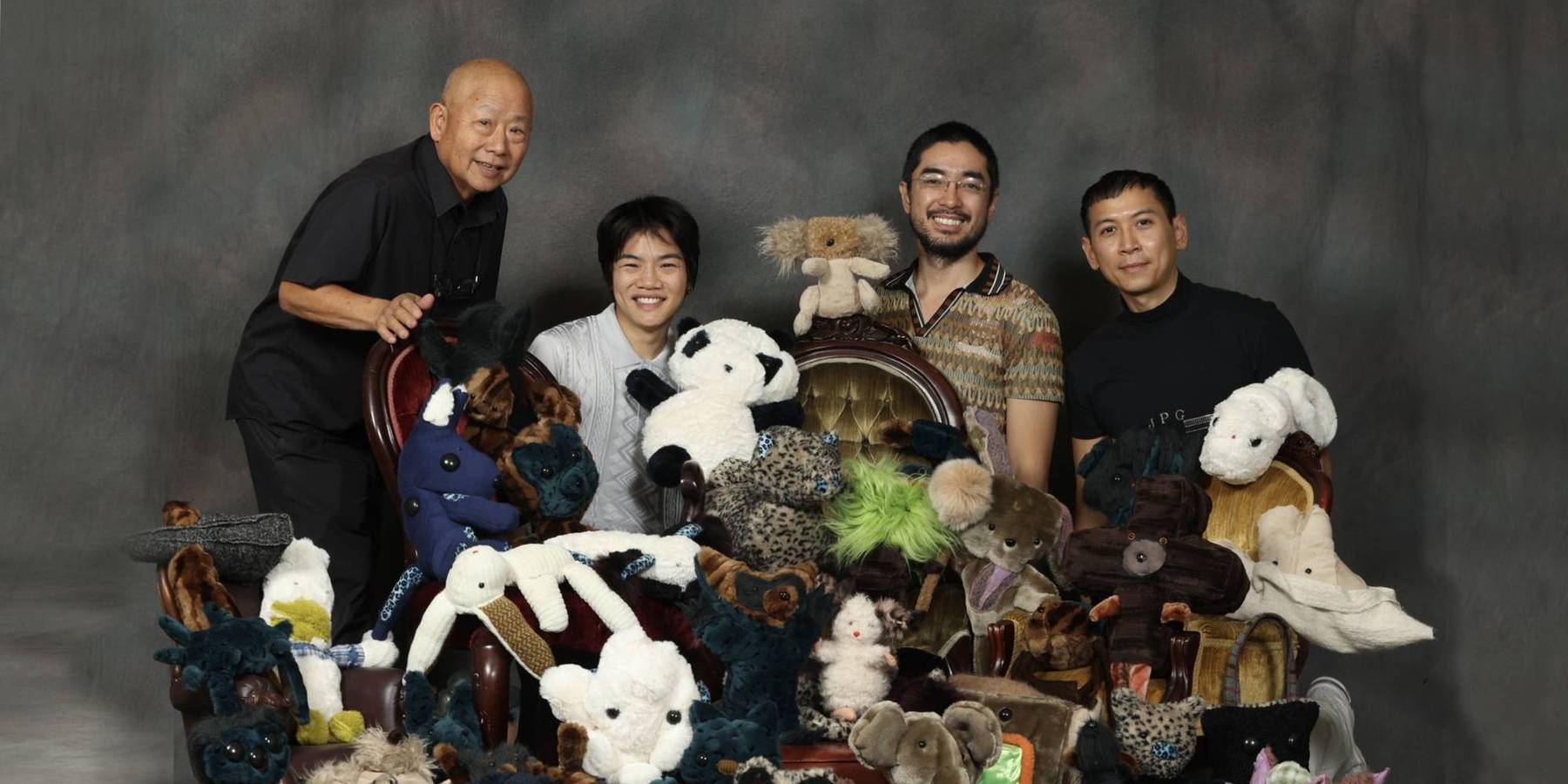
The first time I met the groundbreaking artist collective CFGNY, composed of Daniel Chew, Ten Izu, and Tin Nguyen, I was their intern.
It was 2023, and they were doing a summer residency at the SculptureCenter museum in Queens. Of course, the first thing I asked was what CFGNY actually stood for; it turns out the meaning is meant to change depending on the day and mood. Most of the time, it stands for Cute Fucking Gay New York (a label I proudly identified with.) Other times, it’s Canceled Forever Gone New York, Cult Freaks Galore New York, Canned Fish Group New York, Custom Foie Gras New York, or their personal favorite, Cute Friend Group New York.
What a parade of radical, queer variations on the spirit of New York!
The vagueness behind CFGNY, they explained, gives them the flexibility to resist being boxed into any single artist category — which, as a group of queer, American artists, is a frequent issue. Still, their boldly conceptual, boundary-blurring art is not so easily categorized.
Today, CFGNY is a group on the rise.
While originally known as a clothing label, having released multiple collections centering around experimental textiles and production techniques, they have since become a force in the art world.
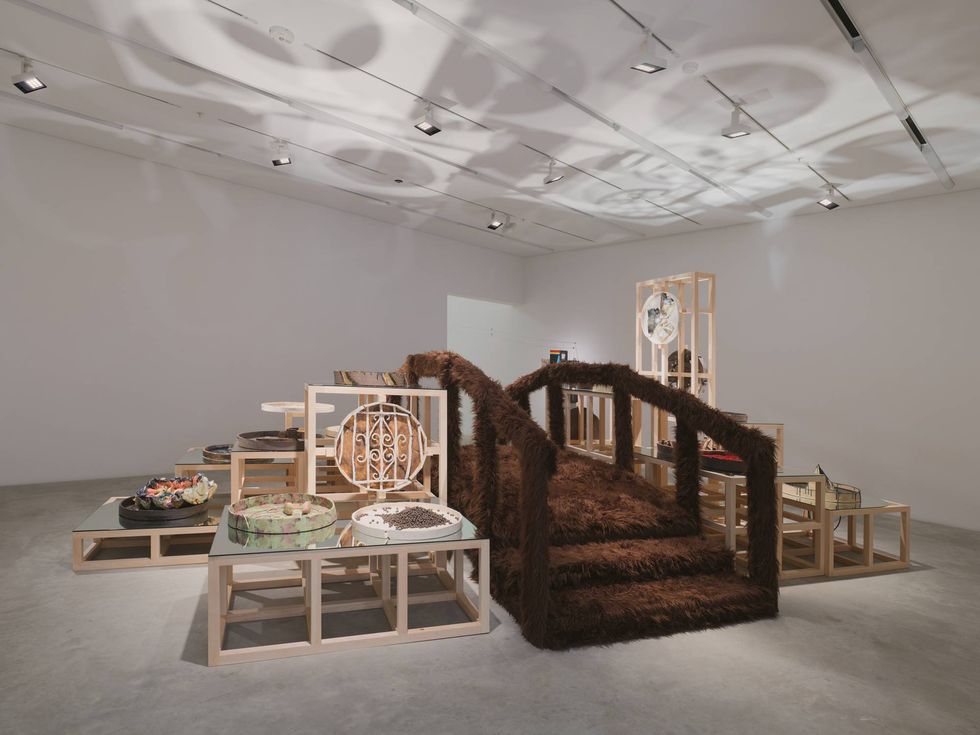
Installation view of CFGNY Puddles into Pond, Amant, Brooklyn, NY. Photo: New Document
This summer alone, they have a veritable New York tour in place, with a piece at the Whitney Biennial, and installations at both Amant and Pioneer Works.
I reconnected with my former bosses at their opening at Amant, at which they premiered their new exhibition Puddles into Pond. Spread across two rooms, the piece pulses with sound and texture; ceramics, faux fur, plastic bags, water jugs and mannequins all find their place in CFGNY’s expansive work. As we speak, Nguyen is perched on a large, furry bridge spanning the center of the first room, surrounded by wooden scaffolding. The structure is meant to support multiple ceramic dishes, each one made by one of the collective’s various friends.
Involving people outside the immediate trio is something CFGNY frequently does; community is an integral part of their artistic language. “So much about our work is about collectivity and collaboration. This time, we invited our friends and a group of artists to make these ceramic works in our studios,” CFGNY explains. (The group often likes to be quoted as one entity in interviews.) “For us, it's about expanding and continuing that relationship in different ways.”
In fact, Puddles into Pond was inspired by another community-based artist collective: the No Name Painting Association, a covert painting group active in Beijing between 1973 and 1981.
The artists met in secret during China’s Cultural Revolution, when art that fell outside the bounds of propaganda was highly discouraged. As a quiet rebellion, the No Name group turned to plein air landscape painting, embracing artistic discourse and freedom of expression at a time when both were essentially forbidden. “They were really valuing and using art as a way to be together. I think it mirrors a lot of the ways in which we think about our practice,” says CFGNY.
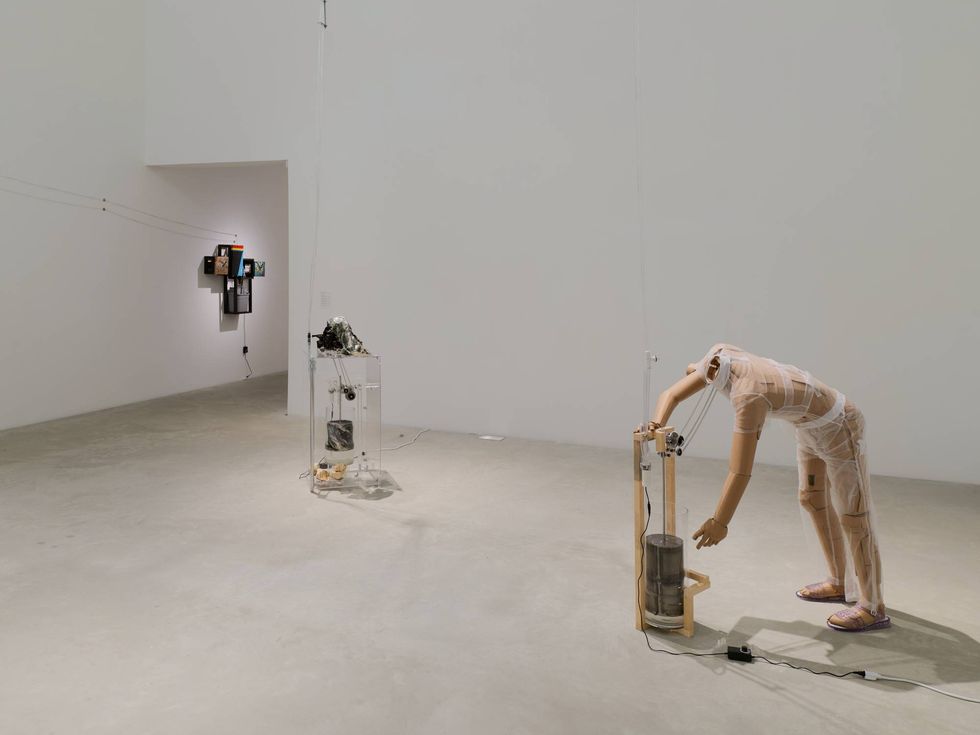
Installation view of CFGNY Puddles into Pond, Amant, Brooklyn, NY. Photo: New Document
The bridge Nguyen is perched on acts as an homage to the landscapes the group painted, arching over an artificial cityscape made of the myriad ceramic dishes surrounding it. “Politically, we're interested in de-hierarchizing everything. When it comes to working as a collective, it's about decentering the idea of a ‘central genius artist’… we're interested in sharing that rather than being like, you guys can work for me or I can work for you. It's like, well, why aren't we just thinking together and crediting each other in that way?”
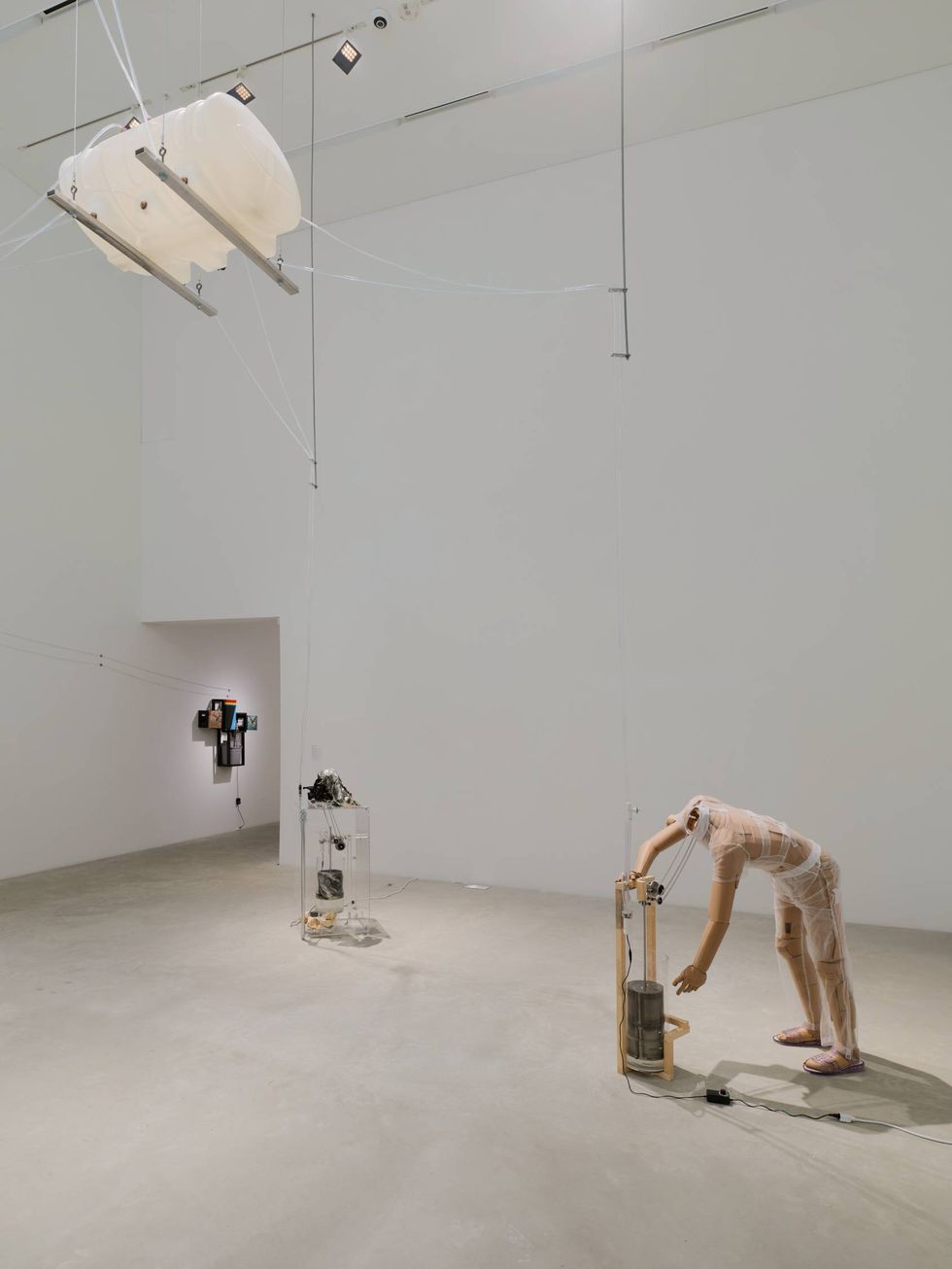
The second part of the Amant show is made of a system of clocks, each one increasing in strangeness. One clock includes a hand on top of a tall concrete tower, which slowly fills with water before finally tipping over and spilling, only to then bounce up and begin collecting water again. Another is a cardboard mannequin, which bows over a cylinder of water; in its arm, a small clock peeks out, hands moving in time to the filling of the cylinder. Each of the five clocks is connected by thin plastic tubes to a water jug suspended on the ceiling, which stares out with stickered-on cartoon eyes.
The water dripping out of the jug powers all the surrounding clocks, which each run on distinct times from one another. Thus, while they may help measure time in an abstract sense, viewers are unable to tell time in the most literal sense. To CFGNY, this is meant to challenge the idea of time as a linear, uniform experience: “As [queer] people who are living in a non-normative timeline with regards to reproduction, marriage, or other types of normative markers of a life, I think experiencing those differences where we're talking about what milestones are between ourselves, and between the people who are around us, is a big part of our life.”
If the clocks disrupt the notion of a single shared timeline, they likewise fold in elements of the collective’s own history. Clothing and accessories from CFGNY’s past fashion collections are embedded throughout the mechanisms. This turns garments, objects often tied to identity and self-presentation, into components of the clocks themselves.
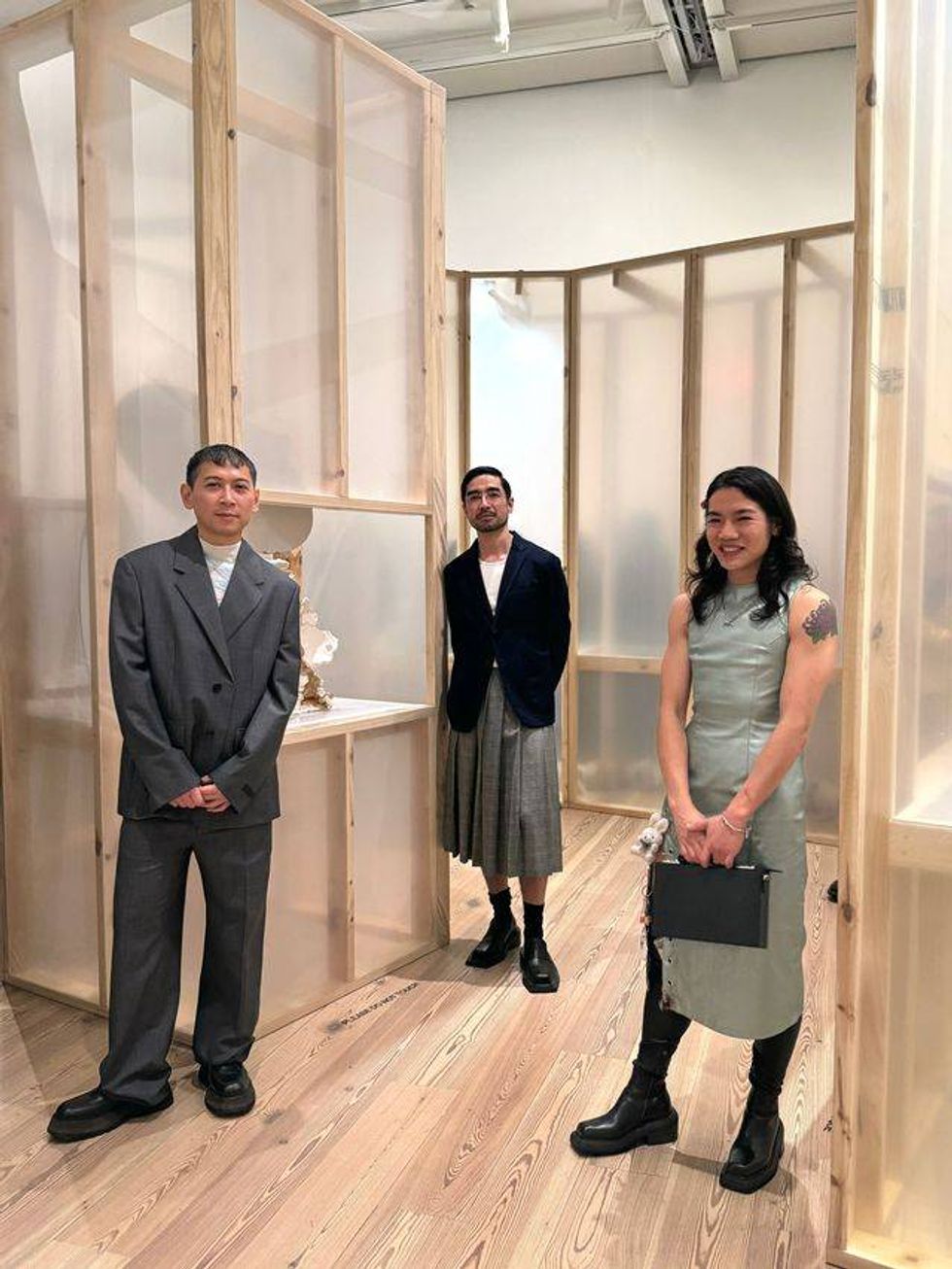
Group photo courtesy of CFGNY, photographed by Alexandra Cunningham Cameron
Their Whitney Biennial piece carries these ideas forward, incorporating elements of the mixed-media Puddles into Pond in a more refined, less “leaky and messy” (as CFGNY humorously put it) way. Titled Continuous Fractures Generating New Yields, it features a sad, stuffed millipede-esque creature winding its way through a makeshift ‘house’ made of plastic sheets and wooden scaffolding similar to their Amant installation.
Frankenstein-ed stuffed animals are a signature part of CFGNY’s artistic repertoire; while adorable, they maintain a creepy element, always an amalgamation of multiple stuffed animals torn apart and re-sewn back together in different configurations. As CFGNY puts it, their work with stuffed animals is a reflection “around this idea of cuteness, and how that has developed in association with Asianness, mostly because of Japanese export culture from the 80s. We’re specifically interested in where cuteness can be both attractive and repelling at the same time.” Mismatched, yet still adorable, these animals are named as numbered family members: Family Member 1, Family Member 2, etc. “We think of them as a ragtag queer family, which is why all together they're called the family.” Thus, the idea of a ‘queer’ or ‘chosen’ family becomes woven into their existence.
The Whitney piece also includes a ceramics series made from the impressions of cheap, dollar-store, “Made in China” goods. “We gather all these dollar store objects and… seal the edges of them with clay, and then cast what is between all of them in plastic.” From that result, they slip-cast a mold that is then used to make the final ceramic sculptures. Sound confusing? Both the process and the result are complicated in nature, and it can be difficult to see exactly what was achieved through this painstaking method. What remains in these ceramic “impression” sculptures are vague outlines of tea kettles, china bowls, plates, and other miscellaneous household objects. Not all of them are easily identifiable, but their “Made in China” origins remain visible through faint traces of chinoiserie designs and ornamental patterns.
These ghostly impressions ultimately point back to CFGNY’s core motto: “Vaguely Asian.” The ceramics, formed from traces of mass-produced objects, mirror the trio’s broader interest in Asian identity being something partial, shifting, and difficult to define.
Similarly, the term “Vaguely Asian” reflects how, for the group, being Asian is less a fixed social marker than a loose cultural bond. The idea is further shaped by the fact that the three CFGNY members come from different parts of the Asian diaspora; as they pointed out in conversation, back in Asia they would likely never be lumped together in the same way, as Asian countries do not share the cultural camaraderie that Americans often assume. As CFGNY shared, “I think we understand Asianness as American… The way in which we even think through the dynamics of how race works is very much rooted to this type of locality.”
Yet rather than functioning as a point of difference, being “Vaguely Asian” allows them to gather under a shared umbrella of identity. Much like the No Name painters - who were not bound by a specific political affiliation but simply by a desire to paint - CFGNY finds common ground in practice itself. And just as painting is an active process that shifts and develops over time, so too are queerness and Asianness to CFGNY: they are aspects of identities that remain fluid, evolving, and difficult to pin down.
During my time as an intern during their summer residency, CFGNY threw multiple parties in the museum’s basement.
Although slightly illicit, and not widely advertised, there was always robust attendance; likeminded artists, curators, fashion-philes and creatives galore filtered downstairs to the dark and windowless basement, lighting it up with music, lively debates and plenty of wine. CFGNY routinely changed out the artworks, and more often than not it wasn’t their work at all. Rather, they used their own residency in order to promote their friends’ art, staging mini-openings for their exhibits and inviting them to the parties as artists in another artists’ space. I was always amazed at their strong sense of community, and how it both bound CFGNY together, and opened them up to other people.
To my delight, their recent works clearly show how that liberated attitude towards identity and community has only expanded as their artistic practice has grown. By casting off the illusion of the individual, CFGNY has managed to open the door to another, more communally utopian and proudly alternative way of living and creating.
Photos courtesy of CFGNY, Alexandra Cunningham Cameron, Toyo Miyatake Studio and New Document