Have the Rockers Returned to Pop Music?
by Cassidy SollazzoAug 11, 2026
Charli xcx's pivot-declaring single "Rock music" was built off a single, scuzzy, thick, overpowering guitar riff.
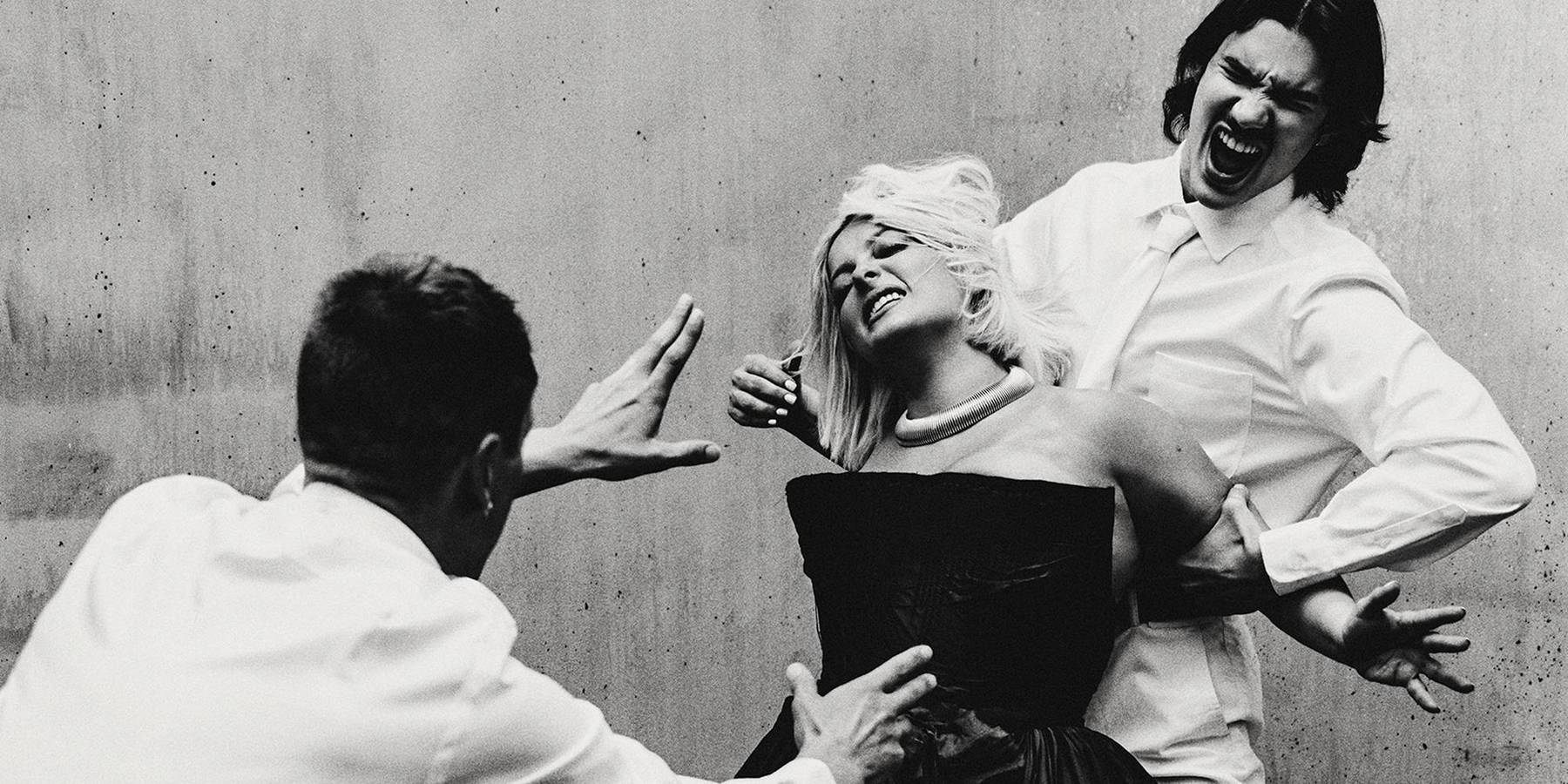
She announced, tongue-in-cheek, that she was "making rockkkkkkkkk music," devoting herself to the sensibilities of the Father, Son, and the Holy Spirit of the Velvet Underground (Lou Reed, John Cale, Nico.) And others were quick to agree, appointing her one of the artists "making rock cool again" in 2026. If you looked too quickly, you could mistake the guitar-smashing, cig-bumming, crowd-surfing black-and-white "Rock music" music video for The 1975 lost media.)
In 2024, David Feigelson coined the term "hyper-rock" for Paste Magazine, highlighting this new type of guitar-centric rock music that combines hyperpop sensibilities with power chords and thrashing riffs. Feigelson calls out everyone from Alex G to feeble little horse, citing their "surrealist indie-rock" and their glitchy textures as token signatures of the genre. Hyper-rock is the idea of rock music leaning poppier and emphasizing vocal manipulations, autotune, and effects (the guitar, since this is a subset of rock music, is a constant.) If hyper-rock is rock music absorbing pop's digital mutations, this is the inverse: pop absorbing the guitar without necessarily becoming rock.
The synth-heavy maximalism that defined early-2020s hyperpop and dance-pop is giving way to songs with fundamentally guitar-rhythm-based DNA. They aren't necessarily pop rock songs, like your Olivia Rodrigos or your Blondshells or your Phoebe Bridgerses. In many cases, they still occupy the same sonic world as hyperpop, but guitar riffs and chord progressions are increasingly becoming the foundation, assuming roles previously dominated by synthesizers and electronic production.
Guitar-forward pop isn't new; artists like Sky Ferreira, Ke$ha, and Lady Gaga blurred those lines in the late 2000s and early 2010s, which is how tracks like "The Fame" or "You're Not The One" got their bite. Recent offerings, however, feel like a distinct evolution. In a pop music landscape crowded with arpeggiating synths, frenzied drum machines, and overpowering basslines, the guitar has returned as a central part of the songwriting process, the foremost beat-thrusting vehicle that would (in hyperpop) typically be a role filled by a synth.
Where hyperpop is mentioned, A.G. Cook must be acknowledged. Cook's PC Music revolutionized synth-heavy, electronic-leaning pop music, with SOPHIE, Yung Lean, and Arca, among others, leading the charge with warbling 808s and disorienting, otherworldly hooks. He was a synth champion, that is, until 2020's Apple and 7G brought guitars back to the fore. He told TANK Magazine in 2021, on blending synths and guitars: "'Person singing while playing guitar' is such a ripe, loaded image, and it will alert people, 'Oh, it's about songwriting.' It's just such a useful tool if you're trying to play with genre and the notion that anything could happen."
He doubled (or tripled) down with the three-disc Britpop in 2024, where tracks like "The Weave" and "Serenade" track the titular genre's past, present, and future, guitars propelling everything forward. Leave it to a hyperpop forefather to be half a decade ahead of the game.
Cook approached the guitar as a way to destabilize genre expectations; 100 gecs treat it with considerably less delicacy. Look up "hyperpop guitar," and you'll quickly be directed to a slew of Reddit threads highlighting the duo's fragmented, oversaturated discography. All of their albums — gecs to every tenth power, 100, 1,000, and 10,000, specifically — sound like one’s radio/speaker/eardrums are melting and the world is crumbling around them. The guitars are the point, giving their music its affronting, blow-your-hair-back physicality. 10,000 gecs album opener "Dumbest Girl Alive" sounds like it could be off one of the earliest Tony Hawk's Pro Skater video games. The riff is both the song's main hook and the structural backbone, while layers of fuzz, distortion, and reverb make it feel enormous enough to swallow everything in its path.
And it doesn't have to dominate the mix to remain fundamental to this generation of pop songwriting. underscores' latest and greatest, U, is a notable departure from the guitar-centric sounds that accompanied her rise. But the instrument remains part of the album's architecture, adding texture to tracks like "Hollywood Forever" and moving into the foreground on the smooth "Bodyfeeling." She recently told Interview: "I definitely felt like a poser every time I was making guitar music. I was like, 'I was never in a rock band, so I have no claim to this.'"
This anxiety gets at what makes this shift interesting: for a generation of pop artists raised outside traditional band culture, or adjacent to it, the guitar no longer necessarily signifies membership in, or a relationship to, rock music. This permeability has grown well beyond hyperpop's immediate orbit.
The irony is that some of the artists most responsible for the guitar's renewed relevance came from a scene built around aggressively synthetic sound.
The guitar is increasingly foundational rather than ornamental, the changing relationship to the instrument now extending across pop's mainstream and experimental edges. Lady Gaga returned to her "Beautiful, Dirty, Rich" roots on Mayhem, emphasizing thick riffs and live instrumentation on "Garden of Eden" or "Disease." Producer Andrew Watt stacked electric guitars across the whole album, but their function shifts from song to song: the riff on "Garden of Eden" shadows Gaga's vocal melody until the two become nearly inseparable, while the rumbling guitars on "Disease" thicken the track's already claustrophobic production.
Rising pop darling Magdalene has pushed that combination of sleaze, electronics, and guitar even further on singles "Red Siren Pick Up" and "Sexual Relations with a Wall Street Banker," keeping fuzzy, meandering riffs prominent without abandoning her songs' synthetic pop foundations. Taken together, it's clear the lineage is circular: the guitar textures that gave late-2000s electro-pop its bite are resurfacing in artists raised in that very era.
For artists outside of those noisier pop lineages, the guitar offers an entirely different set of possibilities. Kelela's alt/experimental R&B is taking a turn for the six-string in her new avatar era. Single "idea 1" is built off acoustic pluckings, giving the track a warmth and fuzz that ground the more ethereal production. On this new sonic terrain, Kelela told NME, "When we say 'guitar,' the implications of that are pretty clear for a lot of people, but for me that's like, 10 different sounds." Her latest LP burrows deeper into the ways she can use the instrument (in all its forms) to blend house, R&B, and pop. That expansiveness may be precisely why the instrument is proving so useful to artists whose music has always resisted genre boundaries.
Slayyyter, meanwhile, opted for pounding riffs and heavy metal sentiments on WOR$T GIRL IN AMERICA, her de facto anti-club music album ("I love punk music, I love hardcore, I love everything in that zone, so I think I just wanted to implement things like that in my own way," she told Rolling Stone.) It makes me think of songs like "YES GODDD," which is basically an electro-punk track in club-pop clothing, the head-banging, ear-canal-scratching guitar fuzz funneled through 2010s EDM breakdowns, or "OLD TECHNOLOGY," the wailing and bending in the chorus adding even more motor-revving grime to the thumping beat. In a live setting, the guitars become even more pronounced, compounding the songs' existing aggression and giving the songs a physical heft that their electronic foundations alone cannot provide.
Pop's recent nostalgia cycles have largely been electronic ones; the guitar itself offers another piece of the past to mutate. Pop stars can borrow its distortion, physicality, and swagger without suddenly becoming rock stars. Charli can call it "rockkkkkkkkk music" if she wants. The distinction is starting to matter less, anyway.