Fire Island Pines usually gets compartmentalized as a space away from everything, and away from New York. But like the city, it’s as difficult to pin down, as inclined to wriggle from one’s grasp; its social and geographical landscape change just when anyone thinks they’ve got the lay of the land. Attendees love to compare it to a “choose your own adventure” endeavor, or a “summer camp,” and perhaps even those descriptors fail to capture the Pines’ complexity.
It’s magic and mayhem, earthy and Dionysian, with enough gravitational force that, depending on whom one asks, inhabitants can end the week centered or completely off balance.
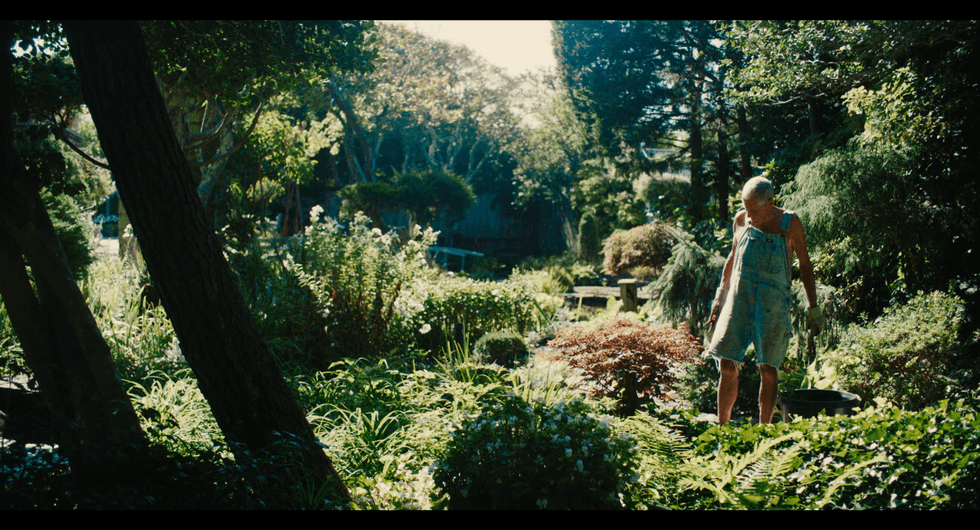
Brian J. Smith, whose acting resume includes Sense8 and the 2013 revival of The Glass Menagerie, admirably tries to craft a wide ranging panorama of Fire Island in his directorial debut A House Is Not a Disco, a free flowing and fluid doc that bounces from a twink who, upon arrival, has lost his wallet, to a couple of older white homeowners that reminisce about the ‘70s and the paratrooper boot fad. There’s the house father making fried chicken and grilled cheese for his residents, or long timers like Studio 54 architect Scott Bramley and Egyptian performer and activist Iman LeClaire.
Through the “year in the life” structure of the doc, Smith observes the various rituals and connections on the island, documenting the change that's happening both culturally and topographically. Fire Island Pines has experienced a kind of renaissance in recent years, with younger homeowners and visitors of a broader demographic set on asserting their right to the island’s unique flavor of hedonism and/or relaxation, while at the same time the coast of Long Island experiences climate change driven beach erosion.
Covering an impressive amount of ground for its brusque 90-minute runtime, Smith illustrates a place that has an exceptional magnetism for queer people with breath and even-handedness; its contradictions are emblematic of the evolving and growing queer community itself.
PAPER hopped on Zoom with the filmmaker to talk about getting access to the Pines Party, performing gender on Fire Island, and how the Pines is like a battlefield. Read our full interview below.
So there's the film that you write or outline, and the film you shoot, and then the film you edit. I was curious as to how A House Is Not a Disco transformed over the course of its making.
It was going to be a documentary about how the Pines Party came together because a really good friend of mine, Alex Klesh, who's one of the main guys in the party, was the first person who approached me with the idea of doing a documentary. He was like, "Listen, I can get you full access to the party. You just got to figure out things from your end, and when I got Eric Schleicher, our cinematographer, interested in it, he was the one who really turned me on to Lance Oppenheim and films like Some Kind of Heaven. Eric said, "Listen, if you want to do a place documentary, I'm more interested in doing something in this lane. It's this sort of cinematic [look].’ It looks like it's shot like a film, but it just does not look like a documentary whatsoever. We were able to get housing out there for a week or a week and a half in March of the year that we filmed. We went out for our first filming thing, and we really had no idea what we were looking for. We had a couple people we knew we wanted to talk to, and at that point we had no idea that the film was going to be this life cycle of the year of the whole place.
We just thought, We're going to go out there and meet as many interesting people as we possibly can and see what comes out of it. One of my favorite things about making the documentary is that there really isn't a script at all. You just need an interesting subject and access to that subject and a really great crew production team behind you to bring it all together in a really professional, artistic way. It really wasn't until our last trip out there, which was that following winter, where we realized, oh, this looks like it wants to be a year in the life of this film.
From there, I had a hard drive with all of our footage on it. It was like 145 hours of footage, and from there, I just kind of scoured through that and started writing a script, pulling time codes and bits of dialogue that would string that idea together, so that when I went into editing with Blake [Pruitt], we had a bible of what the flow of the documentary could be. And then, of course, you put that up, and then it can completely change again, which it did many, many times. But that was the general workflow of the thing.
How big was your team when you were out there filming?
We had our main producer Jeremy Trong, our community liaison producer Joe Conforti, and we had a sound mixer [Kieran Altmann]. We had our DP, Eric. I was sort of the assistant camera guy. I walked around with the tripod and helped set up the camera, and that was pretty much it. We kept it really, really small and guerrilla, and fleet.
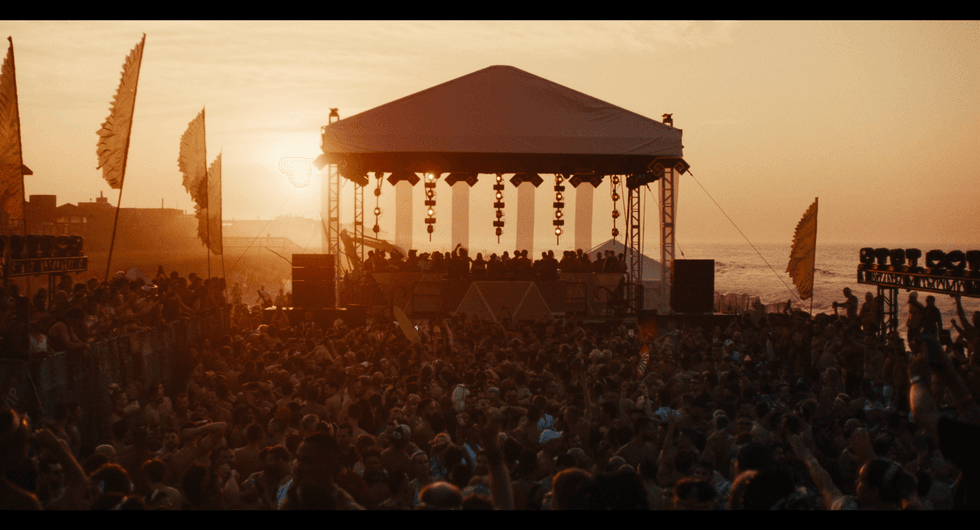
For the Pines Party section, I'm really curious. You get a lot of coverage of it, and I'm curious as to what the logistics were in being able to capture such a large event. Because it feels like the cameras are kind of everywhere at once, capturing the planning meetings, all the materials that are being brought to the beach, etc.
The first big part was just trying to get housing during that part of the year for us to be out there and film because it's the biggest time out there on the island, and it's super super expensive. So we really had to pull some rabbits out of hats to be able to house not just our regular crew, but we also brought in a second camera with an assistant. So we were a slightly bigger crew by that point too, because we also knew that it was such a big event that there was no way we were going to be able to get the scale and impact of the thing that we wanted with just one camera, especially since Eric, our DP, was not just our main camera, but he was also doing all the drone footage.
So, having a second camera that we were able to split up. We were two units, Eric went off with one team, I went off with another team, and we were able to get some things that if we had just stuck to one lane we never would have found. From a production standpoint, it's like it sounds like a really great idea but then you got to figure out how to feed everybody. Once we had all that in place, it was just kind of great. I'd worked with Eric as an actor on a film before, and we had a great relationship and a really nice shorthand together.
The thing we kept saying is we don't want it to look like a documentary. We want it to have a poetry that you can only get out of using a certain kind of lens and being very intentional about your setups, and that was always really really paramount for us.
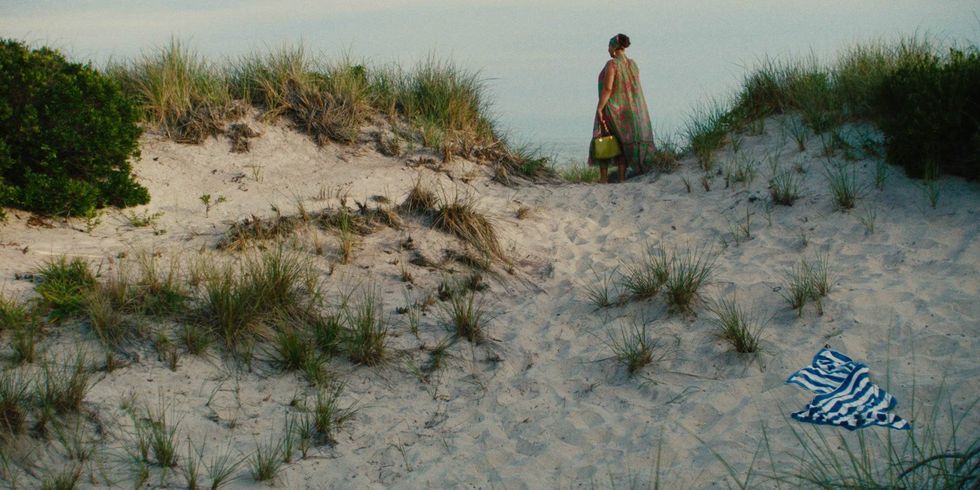
One of the things I find quite interesting about Fire Island is there's a theatricality to it. It feels like everyone is performing their gender, performing masculinity, especially at an 11, and really peacocking these different effects of gay maleness for the most part. And I'm wondering, being an actor coming from the acting world, if you were drawn to any of that, because I feel that there is an undercurrent of observing the way that people are performing for one another in the film.
Yeah, I mean, one of the early books I read about Fire Island was Edmund White's Forgetting Elena, which was kind of interesting that he was inspired by Japanese court mating rituals, and how that somehow transferred over to what was happening in the Pines. And of course, he was writing about the pines in the 1970s. And what's kind of interesting is that the fact that now that we've been through this awful AIDS era, and [now] we [have] Truvada and all of the prophylactic drugs people take to not get HIV, it is like the ‘70s again, and part of that is this very very very intense, concentrated sexuality that's happening out there.
A lot of people feel that you're constantly enacting a mating ritual out there in the way you dress. It's not just about freedom. I mean, people are out there. Oh, this is great! I get to wear a speedo, and I get to dress like I get to wear drag, but there's a highly erotic element too, of showing your body and being proud of your body. And then of course we also try to get into the people who go out there and discover that they're trans and that the way that they transform into their their female identity does not exactly translate into sexual desire in a place like that, and yet that kind of quirky, fun energy that they bring to the Pines is one of the things that makes it so fun and appealing.
It's very theatrical, and even by theatrical, there's a lot of drama, it’s absolutely a dramatic place, and people clash over what the place means and what it's about and what it should stand for, and for a long time it was a tragedy. For a little while out there in the 80s, especially, the place was a tragic experience. So it's just fascinating how it’s been through so many different eras.
Yeah, a lot of this lack of consensus as to what Fire Island means to different people and what their experiences are is fascinating. Something that seems to be a core of the movie is that it is wrapped up in the tension of what people want Fire Island to be versus what it actually is for them. And I was curious as to your experience making that a part of the film and having that be a throughline in the film through the editing process.
I mean, it's definitely colored by the fact that I never had a typical experience going out there. I just went out with my husband last week, and even then, I'm not having a typical experience out there. This would be a very different kind of film if I was one of those muscle gays who's out there looking for group sex and drugs and all that kind of thing, which is there if you want it.
Because it's possibly the most lurid, visible part of the island, it's the unfortunate thing that the island gets pegged with in terms of its identity the most, but there's this whole other side of the iceberg that is not that: there's an art scene out there, there's people that get together and listen to opera, there's the homeowners [that] tend to be older, and they want to, they want to stay home and throw dinner parties and hang out by the pool, right?
It's just because of who I am. The film has that more laid back pace. It's not all about the sex. It's not all about the drugs, and it's not all about the controversy either. It's definitely colored by my own odd way of maneuvering through that space. I never go to Tea, and you never even really see or hear people talk about going to tea in the film. I get it, but I don't like to be in big crowds. I get claustrophobic and nervous. And that was just never my style. My off center way of being in relationship with Fire Island is definitely part of why the film is the way it is.
I read in an interview that you have social anxiety. I also have a bit of social anxiety, and while I've had very good experiences on Fire Island, it can also be quite overwhelming. Very sensory overload. And with that awareness, I was curious as to how that experience has shaped wanting to approach certain people to be in the film, wanting to create these relationships with subjects subject.
Yeah, the great thing about making films, or even acting, is that there's safety behind the mask. I feel I had a lot more bravery dealing with people when I'm assuming the identity of the documentary filmmaker. It gives you a certain license, and the rules of engagement with people are different.
When you're just interacting with people in a bar or on a date or just meeting people for the first time, those those rules are part of what can make people like us feel so anxious is that we're trying to figure out what those rules are, trying to figure out, what kind of game are we playing, and are we even going to be playing the same sport? And at the same time, am I annoying the hell out of you? Being a film director or being an actor or being a producer, these monikers– they're kind of magical in a way, and allow us to interact with people in ways that we normally wouldn't. So there are people out there that I never would have met if it weren't for this film, that I never would have had the courage to approach, or an organic reason to talk to. So a great argument for documentary filmmaking is it’s a great socializing experiment. It really gets you out of your shell in a way.
Yeah, absolutely. I mean, I was there last summer, and I had my camera with me, and it made it much easier to navigate certain spaces. And I had the brief thought that having a camera is like a jester's privilege.
It also is kind of terrifying. Eric Schleicher, our DP, has no fear. He is fearless, and he's one of these anything-for-the-shot kind of guys. And there were moments when we were doing the Pines Party, where I was like, I don't want to get too close to this group of people right now, I'm getting a kind of energy that they want us to go away. And Eric is like, boom, camera, right on them.
He really had no fear; he's not being rude, but he's just going to do whatever he has to do to get the shot until someone politely says, "Oh, please, you shouldn't be here.” He's got a little bit of the paparazzi in him, in a good way, and you have to have someone on your team who is like that and is willing to drag you out of your comfort zone in order to get interesting stuff. I mean, if it weren't for Eric, this film would not be as interesting as it is because I probably want to play it safe way too much. So I'm grateful to have people on my team who are helping me get out of that zone.
There's obviously a legacy of films that have been shot on the Pines, like Boys in the Sand and Longtime Companion, A Very Natural Thing. And I was wondering if any of those movies were in the back of your head as far as trying to map out what you wanted the visual language of the film to be.
You have to know it and forget it. You got to do your research and then just trust that it's there in your nervous system. It's all a conversation, right? Crayton Robey, who lives out there, did a documentary called Where Ocean Meets Sky (2003), which is really beautiful, and it really gets into the history of the place. If anything, I was very conscious of not having an air of going in there and being like, we are making the definitive film about the pines.
Some people go there and think that their job is to make the statement about a place. We were always very clear from the beginning that it's kind of impossible here. We are just there to document the way we experience this place, and it's going to be completely different from the way other people see it, and we wanted to be fair, and we wanted to not treat people as villains or victims. It's kind of like learning your lines. You go, you research, and then you just trust that it's there.
And as far as research goes, and you've talked about memory in the film before, I'm curious as to at what point in the process you wanted to include archival footage and the ephemera, which is really cool.
Yeah, there was a while where we thought we were not going to use archival footage at all; that we were going to keep it clearly, very firmly set in the present tense. But it's really impossible to think about the Pines and the forces that make it what it is today, without understanding the major tectonic shifts that have taken place out there since the ‘60, ‘70s, and ‘80s. The coolest thing that we did was being able to license footage from Boys in the Sand (1971), which is Wakefield Poole’s gorgeous gay art porn that was filmed out there in the ‘70s.
Yeah, it was before Deep Throat (1972).
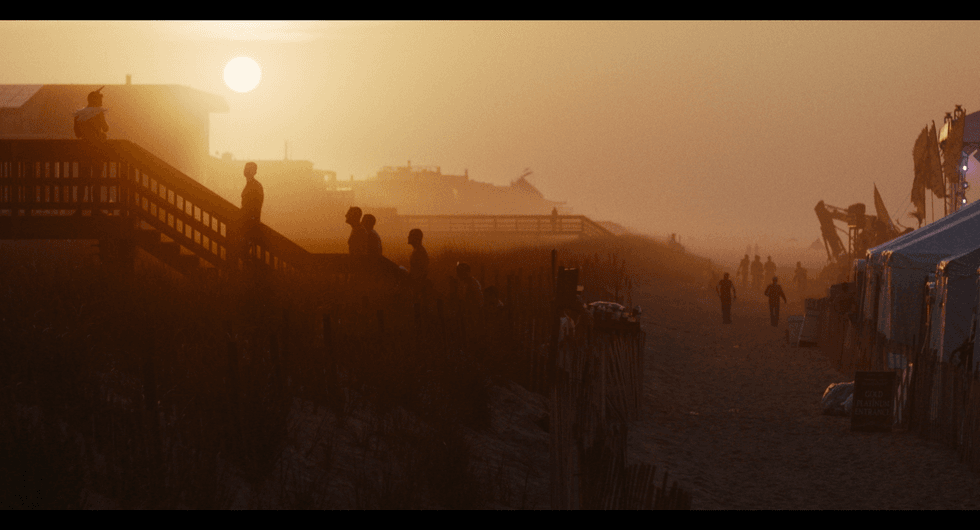
We asked them on a lark if they would work with us on it. And they were very sweet about it. I'm only interested in archival in a film like this, in terms of what it does for a sense of memory, right? It's not just about the factual information you're learning about, it's more like it happened here, like the boardwalks that we're filming in, and the houses that we're filming in, and the parties that we're at, and the beach that we're on. Sort of like going to a Civil War battlefield. There's this sense of it being haunted by the events that took place there, and, not that Fire Island is a battlefield, but so much and so much intensity has taken place out there that I've always been very aware of it, and you can feel it out there.
Fire Island may not be a battlefield, but the film does touch upon the cultural changes that are happening there. There's a very interesting conversation that happens between two older Black men as far as the Trailblazers Park that is being erected, there's a conversation towards the end of the film with two older white homeowners talking about the classism that sometimes rears its head on the island, which also brings in another element as far as there's an upstairs-downstairs quality to the documentary. You're obviously like looking at the people who are able to party and able to go to all these different house parties and whatnot, but you're also examining the people who are working the Pines Liquor Shop and working at the pantry. I'm curious as to how much was Fire Island changing as you were filming?
We were kind of lucky to be there right when Trailblazers Park was being built and being finished and dedicated because it was very controversial. They hadn't made any changes to the bay or the north side of the island. It had always looked very much the same and by design. Especially after COVID and after George Floyd and the Black Lives Matters movement, that there was a real call for places that, A lot of people in the community represented white privilege, that they make a statement about where they stood in terms of their values, right? And I feel like Trailblazers Park was this effort to show, “Yes, we hear you, and yes, these people who are a part of our history who have not been known very well.”
I mean, it's amazing how many people don't know Sylvia Rivera. The community really was trying to reach out and say, We are more than just a bunch of roided out muscle queens in speedos having orgies out here, right? And what was interesting was that it was a controversial move, and there was pushback for all sorts of reasons.
Fire Island is in this really uneasy space of, is it a vacation destination? Is it a neighborhood? Is it a public [beach]? What is it? It's too far away to be just a place where you can just go for a day and go to the beach and get drunk and hang out, right? People live there and they spend millions and millions of dollars just keeping their houses up, and people have very complicated feelings about how much the place should change. They really have very complicated feelings about preserving the history of a place.
When we were out there, it was at this little moment where the history and the reputation of the place were meeting up with these activists, who were out there and saying, No, we need to have space out here. And it was interesting too because it was always, what does that even look like? What does it mean to have space out here, right? Does it mean that there need to be more trans homeowners? More Black homeowners? And what's the policy to make that happen? And there are no answers to those questions. Like a lot of things out on the island, it's aspirational.
That's what I always appreciate about the island. And some would say, ah, this is just performative, but the place really does have utopian aspirations. No one out there just wants it to be an enclave for privileged rich people. But there are certain natural barriers in place – the distance, the expense of it – that keep it from being this utopia that people want it to be. We tried to get into that as much as we possibly could in the film, and I was grateful that we got as much of it in there as we did because it's a very interesting, unresolvable, intractable problem.
Was this before Doll Invasion, or had that already started ramping up?
That had started the year before. There were so many things, by the way, that we wanted to cover, and when you have a 90-minute film, there's only so much you can cram in there.
Now I know Frederick Wiseman was a reference point for you. Oh yeah, could you talk a little bit more about that? And was there any particular film in his body of work that seems to embody the things that you were trying to achieve with your film?
I stumbled on Frederick Wiseman when I was researching Lance Oppenheim, and I was reading a whole bunch of interviews with [Oppenheim]. There's the one that's in the skiing community in Colorado.
Aspen (1991).
Aspen. I watched Aspen, and there's the one that takes place. What is it? Not Horse Meatt, the Burlesque Club in Paris. [Crazy Horse (2011)] Then also the one about the running of the National Theater in Paris. [La Comédie-Française (1996)]
The one that's four hours long.
I remember I was so jealous watching these films, because I was like, oh man, if I had four hours, if I was allowed, there is a four-hour version of this film. That was the observational, granular, really getting into the weeds of a place and not caring if it's boring or repetitive– there’s a spirit to that that I did sort of steal, because it's not a conventionally structured documentary. It's definitely slower-paced.
I got the bravery to do that watching Frederick Wiseman films, and learning about a new world is inherently fascinating, and sometimes you just have to trust that. There was a moment too when we had talked about the film being a pure Frederick Wiseman experiment, no interviews at all.
We found that that just did not work out there for a couple reasons. I mean, gay people like to talk, and they're great talkers. And there were stories to be told out there, and there is an oral tradition out there of people talking about the past and passing it down, where the Pines Party came from and what the legacy of HIV and AIDS was out there, and you can't get those things just watching the Fourth of July invasion.
We were so limited in what we could film because the place is so private. The parties that we were able to film, just getting the clearances with those, it was insane. Getting the clearances to film for the Pines Party and all that was a huge deal, and it's one of the major technical issues of filming out there. People go out there to get fucked up and to have fun and to relax and to not worry about cameras, and we had to be very careful about what we could film. I remember [Wiseman] saying the only way he will film in a place is if they give him absolute 100% access. So I don't think he would enjoy filming out there, because you absolutely cannot do that there.
You've lived with this film for a little bit now. I'm wondering if your relationship to the island has changed as you've had to craft a narrative around the filmmaking around it, around your relationship to the film, around your relationship to the island itself. Doing press for it. If your relationship to your actual experiences there has changed at all.
It opened up a whole new social world for me, which is great. The Pines is still a place I'm going to go to. It will always be a place in my life where I will, one week a year, maybe two in the summer, go out and stay with friends and hang out by the pool and go to the beach.
The biggest thing is going out there now, being married. That changed the island even more than making the film. I just have more memories out there now, and I'm also glad that I feel I can go out there and show my face and not be ashamed of what we made. That was very important to me, that we didn't make an exploitative film, that was mean-spirited, that took advantage of the trust and the time that people gave us and made a hit piece, which, to be honest, is probably what [would be] the HBO documentary of this place, or the Netflix documentary.
The only thing that people want are headlines and villains and black and white, good versus evil, and I just refuse to make that kind of movie, and thankfully, because of that, I feel we were very fair, and I can go out there and see people, and they appreciate that we tried to tell their story, but we also tried to tell it as honestly and complicatedly as we possibly could, and with some heft. But the Pines will always be a place I go to.
You go out there, and there are all these little ghosts of you on different street corners and in different houses and in different parts of the beach out there, still playing around. And it's nice to go out there and see those ghosts again and realize how you've changed and how the place has changed. It's important that we have those places.
A House Is Not a Disco is now available to rent and stream on Gathr.
Photography and stills courtesy of Brian J. Smith